
TSLA Retail Ownership Hits All-Time Low 17.9% — Institutions at Record 55.2%
Published · Updated · By Investus editorial desk (SUNRYU Partners)
Fintel 13F data shows Tesla retail investor ownership fell to an all-time low of 17.9%, while institutional ownership reached a record 55.2% across 4,966 institutions. The pattern suggests 'big money' is front-running Cybercab and Optimus launches.
What happened
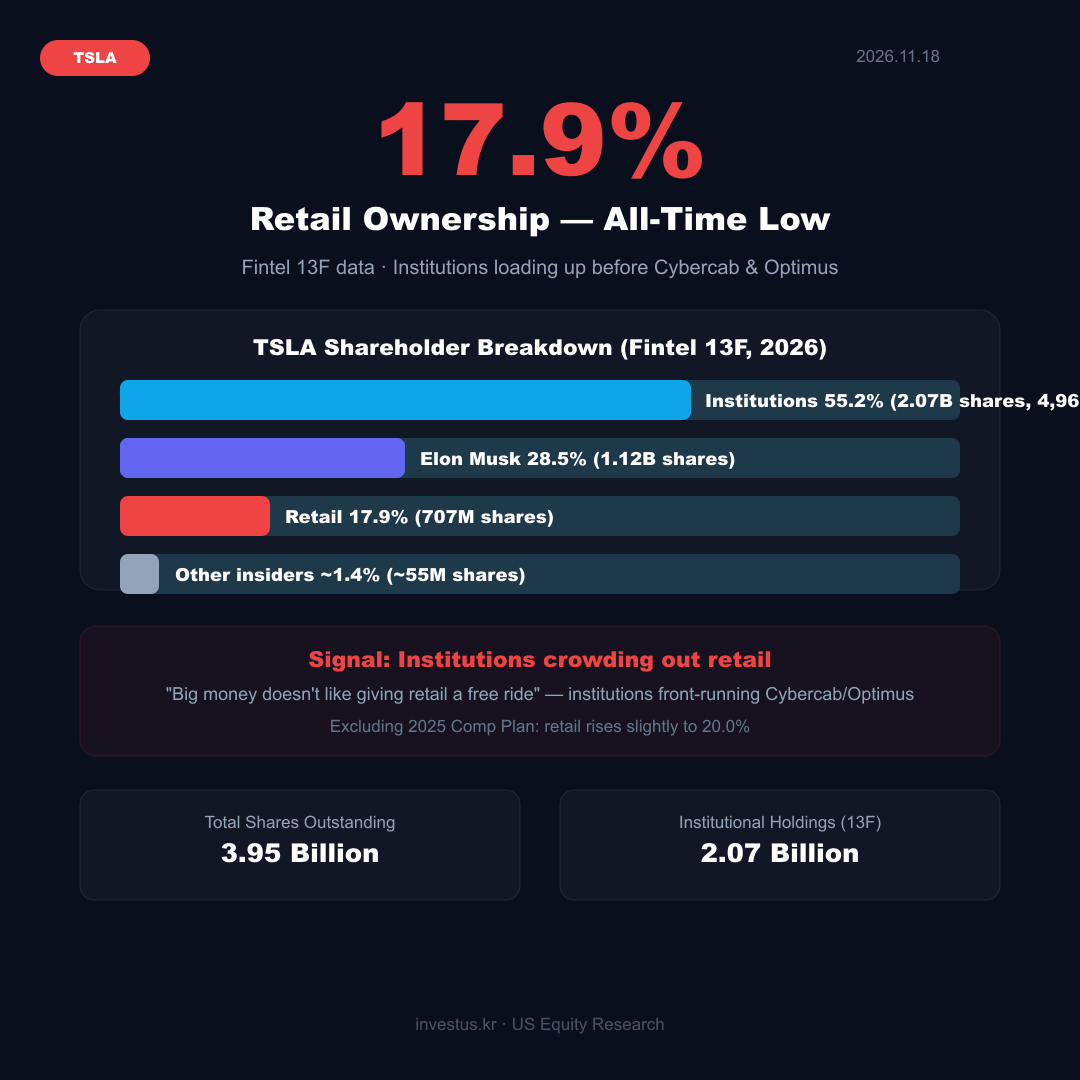
Fintel's latest 13F aggregation shows Tesla (TSLA) retail investor ownership at 17.9% (~707M shares) — an all-time low. Institutional ownership is at 55.2% (4,966 institutions, 2.07B shares) — an all-time high. Elon Musk holds 28.5% (1.12B shares); other insiders hold ~1.4% (~55M shares). Total shares outstanding: 3.95 billion.
Excluding the 2025 Compensation Plan shares, retail rises slightly to 20.0% — but still at a record-low level either way.
What the numbers say: institutions are crowding out retail
Compare this to 2020–2021 when Tesla was still a retail-driven stock — not yet S&P 500-indexed, with individual 'believers' as the primary price driver. Post-S&P 500 inclusion in December 2021, passive institutional flows arrived automatically. What's different now: the 4,966 active institutions holding 2.07B shares suggests active accumulation well beyond passive index buying. The retail-crowding-out pattern is a classic 'big money doesn't give retail a free ride' scenario — institutions positioning before high-margin future businesses are priced in.
Timing: front-running Cybercab and Optimus
The record institutional ownership peak isn't coincidental. Tesla's robotaxi (Cybercab) service is running driverless in 6 cities; Optimus commercialization is approaching. When both scale, Tesla's revenue model transforms:
1) Cybercab: At $1.50/mile, 10 hours/day per vehicle, that's ~$50K/year per unit. At hundreds of thousands of units, this is high-margin, recurring revenue unlike traditional vehicle sales.
2) Optimus: At 1M units/year target and $20K/unit, that's a $200B revenue scenario. External B2B contracts are expected to begin at scale in 2026–2027 based on internal Gigafactory deployment progress in 2024–2025.
Retail at 17.9% means retail investors sold into institutional buyers at scale. The 'smart money' got there first.
Fintel 13F data caveats
13F filings are required only from institutions managing $100M+, submitted within 45 days of quarter-end. They cover long positions only — not shorts or options hedges. The 55.2% institutional figure could include some hedged positions. However, 4,966 discrete institutions building positions is a broad-based institutional ownership signal regardless of individual hedging strategies.
Historical parallels
Record institutional accumulation ahead of a business model transition is a recognizable pattern. Amazon showed similar dynamics before AWS revenue became visible in earnings. Nvidia's institutional concentration spiked in 2022–2023 ahead of the AI boom. If Tesla is in an analogous 'institutionalization transition' phase ahead of its software/robotics revenue inflection, the current ownership structure is a medium-term signal of significant weight.
Analyst views
JPMorgan maintains Neutral ($430 target) but has become more constructive on robotaxi, citing Austin's weekly miles surpassing Waymo as the first quantitative validation of Tesla's FSD expansion speed advantage. The institutional record / retail low is not a near-term price timing signal, but it is a medium-term positioning indicator from the most informed capital allocators in the market.
Sources & further reading
Related Guides
Related articles
Nov 18 — Orbital Compute Roadmap · $985M DoD Contract · TSLA Institutions Record · Powercore · Smart Money · SPCX $850 Target
SpaceX CFO revealed a 2027–2029 orbital compute roadmap and secured a $985M Air Force contract. Tesla hit record institutional ownership and unveiled Powercore. Druckenmiller and Burry loaded SPCX. Raymond James issued SPCX $850 / RKLB $80 Strong Buy targets.
Tesla Powercore Unveiled — 7.4MW Solid-State MV Transformer · Inverter · Breaker, Ships 2027
Tesla announced the Powercore: a 7.4MW / 9MVA solid-state medium-voltage transformer, inverter, and circuit breaker in one unit. Made in America, operating 2027. Positioned as Tesla Energy's next growth pillar after Megapack.
Tesla research note (2026-11-17)
Disclaimer
This article is editorial research for informational purposes only. It is not investment advice, a recommendation, or a solicitation to buy or sell any security, and does not guarantee any return. Markets carry risk of loss. Verify figures against the primary sources before making decisions.