Tesla Powercore Unveiled — 7.4MW Solid-State MV Transformer · Inverter · Breaker, Ships 2027
Published · Updated · By Investus editorial desk (SUNRYU Partners)
Tesla announced the Powercore: a 7.4MW / 9MVA solid-state medium-voltage transformer, inverter, and circuit breaker in one unit. Made in America, operating 2027. Positioned as Tesla Energy's next growth pillar after Megapack.
What happened
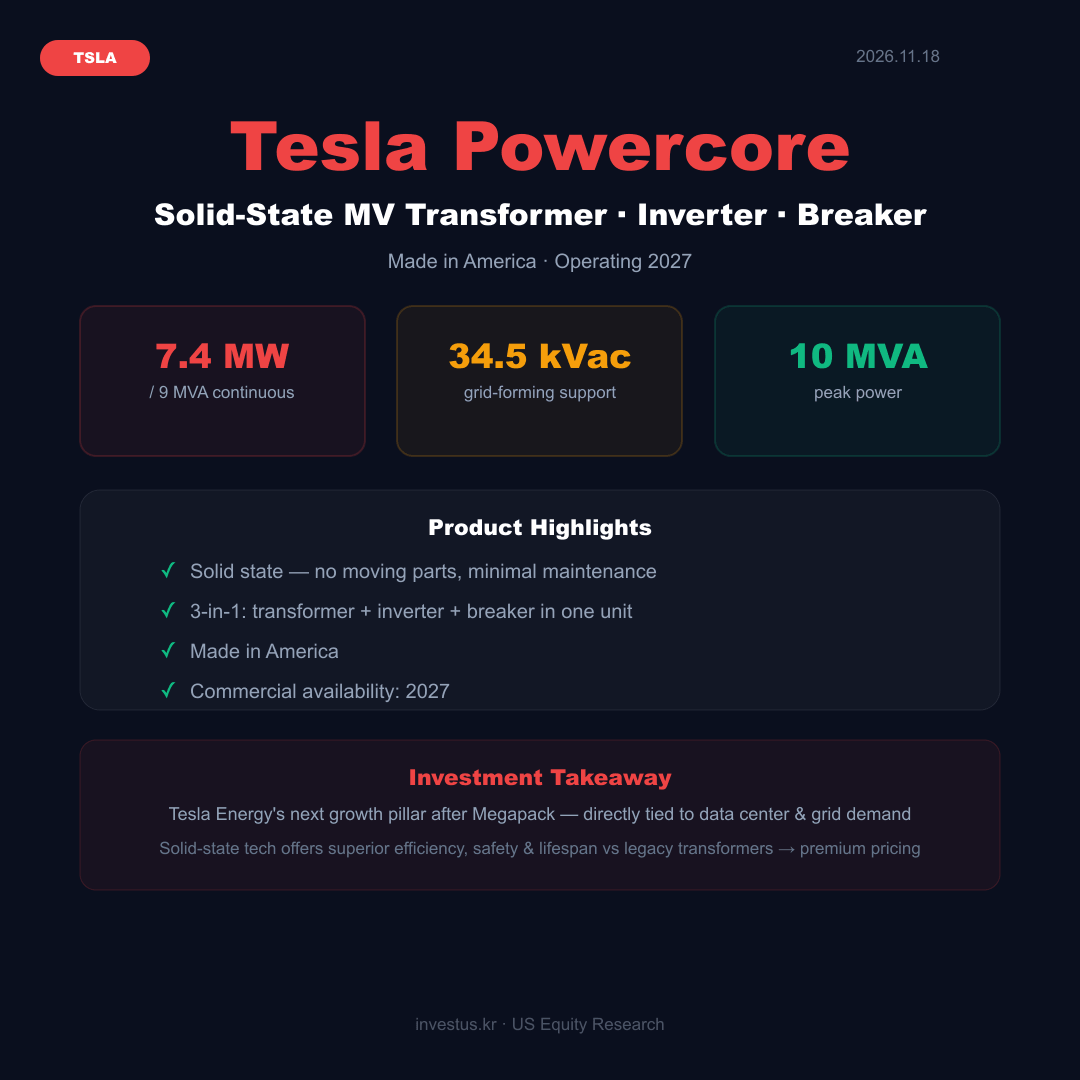
Tesla unveiled the Powercore — a solid-state medium-voltage (MV) transformer, inverter, and circuit breaker integrated into a single unit. Specs: 7.4MW / 9MVA continuous, 34.5kVac grid-forming support, 10MVA peak, Made in America, operating 2027. Tesla positions this as Tesla Energy's next growth vector after the Megapack.
The problem Powercore solves
Conventional MV transformers are oil-insulated mechanical devices with many moving parts. They require regular oil changes, maintenance cycles, and are vulnerable to heat and moisture. Transformer, inverter, and circuit breaker are three separate pieces of equipment — large installation footprint, high integration cost. Much of the US grid runs on aging legacy transformers.
Powercore's three innovations:
1) Solid State: semiconductor-based, no moving parts. No oil, minimal maintenance, improved durability. Solid State Transformers (SST) outperform conventional transformers on efficiency, reliability, and lifespan across all three dimensions.
2) 3-in-1 integration: transformer + inverter + breaker in one unit. Dramatically reduces installation space and system integration cost. Optimized for data center coupling and large-scale solar/ESS interconnection.
3) Made in America: US manufacturing may qualify for IRA incentives and government procurement preferences.
Market size and opportunity
The global power transformer market is estimated at ~$60–70B (2024), growing at 7–10% CAGR driven by AI data center expansion and EV charging infrastructure buildout. MV transformers (1kV–35kV range) are a major segment within this.
The critical context: AI data centers. Large AI facilities consume hundreds of MW to GW. Connecting to high-voltage transmission lines requires MV transformers — no way around it. With the AI infrastructure buildout continuing through 2025–2027, demand for high-quality, high-reliability MV transformers is surging. Powercore's 7.4MW / 9MVA rating fits mid-size data center unit connections well; multiple units in parallel scale to large facilities.
Tesla Energy's growth path beyond Megapack
Tesla Energy exceeded ~$10B annual revenue in 2024, growing to over 10% of Tesla's total revenue. Megapack deployments are surging, compensating for auto segment growth moderation.
Powercore targets a different market than Megapack. Megapack = grid-scale energy storage (batteries). Powercore = power conversion and management infrastructure. Combined, Tesla can offer a full energy infrastructure package — storage + conversion — to data centers, industrial facilities, and renewable energy plants. If Megapack + Powercore bundling takes hold in the data center market, Tesla Energy's B2B business reaches a new scale.
Competitive landscape and challenges
Incumbents — ABB, Siemens, Schneider Electric, Eaton, GE Vernova — have decades of field references and technical certifications. Tesla will need early customer wins, grid interconnection certifications (UL, IEC), and field installation references to penetrate the market.
Solid-state transformer technology is still early-stage commercially. The 2027 operating timeline depends on manufacturing ramp and field test results. Tesla's key advantage: it can build early references by deploying Powercore in its own Gigafactories and Supercharger network before selling externally.
Analyst views
Formal Wall Street coverage on Powercore is early-stage. But with Tesla Energy's Megapack precedent — a new product category that grew into a $10B+ revenue contributor within a few years — Powercore represents additional energy segment optionality. Positioning at the intersection of AI data center power demand and next-generation grid infrastructure strengthens Tesla's AI infrastructure theme alongside Dojo, robotaxi, and Optimus.
Sources & further reading
Related Guides
Related articles
Nov 18 — Orbital Compute Roadmap · $985M DoD Contract · TSLA Institutions Record · Powercore · Smart Money · SPCX $850 Target
SpaceX CFO revealed a 2027–2029 orbital compute roadmap and secured a $985M Air Force contract. Tesla hit record institutional ownership and unveiled Powercore. Druckenmiller and Burry loaded SPCX. Raymond James issued SPCX $850 / RKLB $80 Strong Buy targets.
TSLA Retail Ownership Hits All-Time Low 17.9% — Institutions at Record 55.2%
Fintel 13F data shows Tesla retail investor ownership fell to an all-time low of 17.9%, while institutional ownership reached a record 55.2% across 4,966 institutions. The pattern suggests 'big money' is front-running Cybercab and Optimus launches.
Tesla research note (2026-11-17)
Disclaimer
This article is editorial research for informational purposes only. It is not investment advice, a recommendation, or a solicitation to buy or sell any security, and does not guarantee any return. Markets carry risk of loss. Verify figures against the primary sources before making decisions.