NYT: Musk Dreams of a Conglomerate — What SpaceX-Tesla Merger Means for Tech Supremacy
Published · Updated · By Investus editorial desk (SUNRYU Partners)
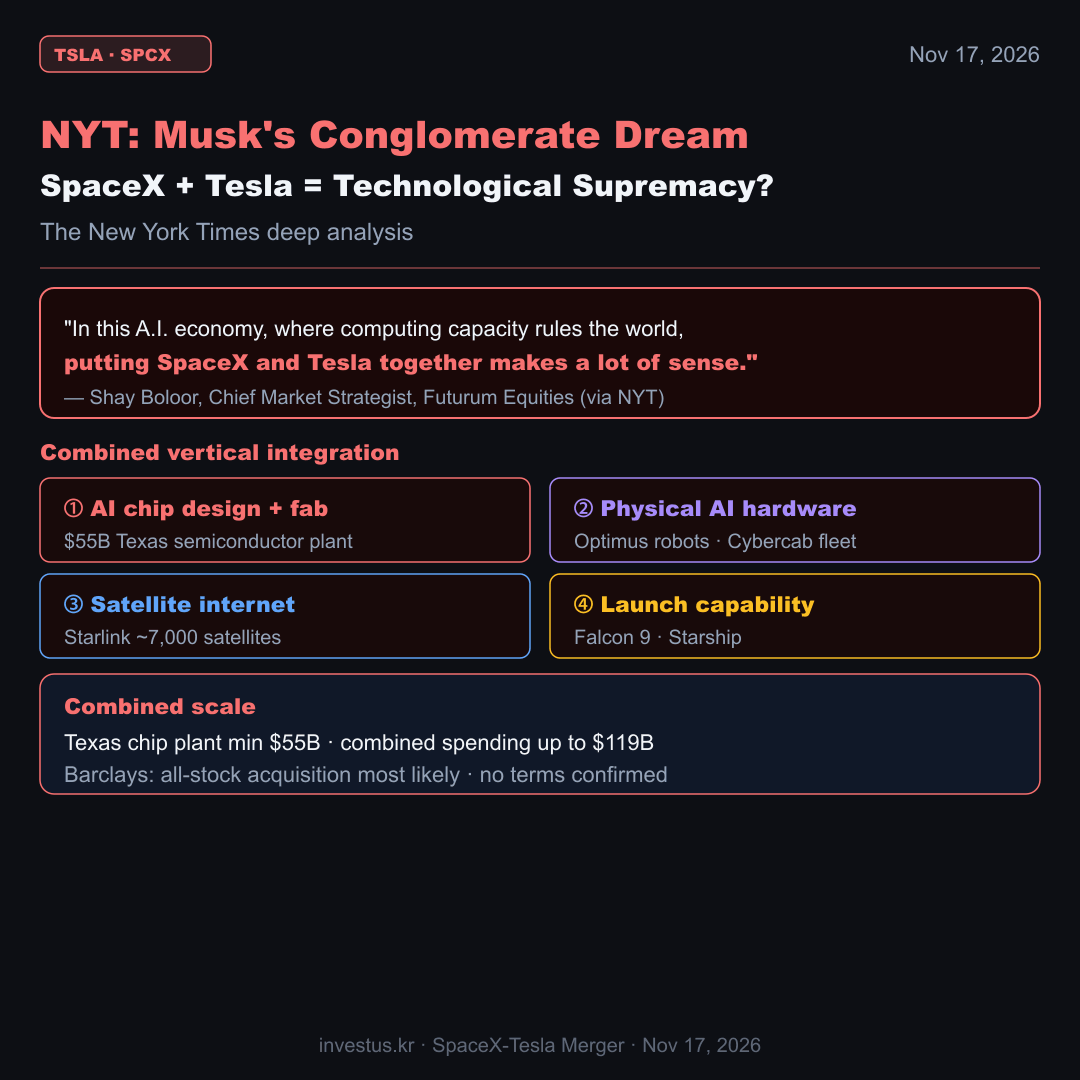
The New York Times analyzed the SpaceX-Tesla merger scenario under the headline 'Elon Musk Dreams of a Conglomerate.' An analyst told the paper: 'putting SpaceX and Tesla together makes a lot of sense' in an AI economy where computing capacity rules. A $55B Texas chip plant and $119B combined spending are cited as anchors.
What happened
The New York Times published a deep analysis headlined "Elon Musk Dreams of a Conglomerate in Move Toward Technological Supremacy," examining the SpaceX-Tesla merger scenario with input from Wall Street analysts.
The paper notes that "some analysts say an A.I. conglomerate may well enjoy advantages as the technology is increasingly widely adopted. A combined SpaceX and Tesla, they say, will have greater power to develop, buy and build the technology and deploy it across industry after industry."
The existing SpaceX-Tesla collaboration in Texas — an at-least $55B AI chip plant with combined spending potentially reaching $119B — is cited as evidence the integration is already underway.
The strategic logic of the merger
Shay Boloor, chief market strategist at Futurum Equities, told the Times: "In this A.I. economy, where computing capacity rules the world, putting SpaceX and Tesla together makes a lot of sense."
A combined entity would vertically integrate:
1. AI chip design and manufacturing (SpaceX Texas fab)
2. Physical AI hardware — Optimus robots, Cybercab fleet (Tesla)
3. Satellite internet infrastructure — Starlink (SpaceX)
4. Launch capability — Falcon 9, Starship (SpaceX)
This is the space-and-AI equivalent of what Apple achieved in hardware-software integration, or what Amazon built in commerce-cloud-logistics. The key difference is that SpaceX and Tesla already share significant technical overlap today — Tesla FSD leverages Starlink V3 connectivity infrastructure, and Optimus AI training uses both Tesla Dojo compute and Starlink cloud infrastructure. A formal merger would codify synergies that are already operating in practice.
Structure, precedents, and what comes next
Barclays sees an all-stock SpaceX acquisition as the likeliest outcome. No terms or regulatory filing has been disclosed. Texas officials have signaled potential scrutiny. A Tesla shareholder vote would be required.
TSLA is down ~13% YTD. For Tesla holders, a merger gives access to SpaceX's private valuation — but dilution risk depends entirely on the exchange ratio. SpaceX remains a private company despite SPCX listing; any formal merger would require its own independent valuation process, which introduces uncertainty on both sides.
Historically, tech conglomerates succeed when the vertical integration is genuine and synergistic (Alphabet: search, cloud, autonomous driving, health), and struggle when assets are loosely connected. SpaceX-Tesla's existing technical interdependencies put it closer to the former category — the AI-physical stack they'd create has no comparable precedent in the market today.
Why NYT coverage matters beyond the story
A New York Times deep-dive with named Wall Street analysts citing specific figures ($55B chip plant, $119B combined) is not just a report — it's the moment a thesis enters mainstream financial media. Even before any formal announcement, this coverage re-activates the merger narrative for institutional investors who may have dismissed earlier speculation. The specific analyst quotes and dollar figures give the story credibility that moves it from fringe thesis to mainstream investment debate.
Analyst views
Citi raised SpaceX to $280, noting merger optionality as a near-term catalyst. Barclays calls all-stock acquisition the most likely path while emphasizing nothing is confirmed. The NYT coverage itself — with named analysts and specific dollar figures — is a signal that the merger narrative has moved from early speculation to mainstream investment thesis, regardless of whether a transaction ultimately occurs.
Sources & further reading
Related Guides
Related articles
Tesla research note (2026-11-17)
Tesla Commits €2B More to German Gigafactory, Plans to Hire 10,000 Workers
Tesla is investing an additional €2 billion in its German Gigafactory in Grünheide and plans to hire 10,000 more workers. The move significantly expands European production capacity as Tesla navigates EU tariffs on Chinese imports.
Tesla Robotaxi Passes Waymo in Austin After Just Three Months
Tesla's Austin driverless miles hit 438,000 per week, exceeding Waymo's Q2 2026 average of 406,000. Waymo took nearly two years to reach that scale in Austin; Tesla did it in roughly three months.
Disclaimer
This article is editorial research for informational purposes only. It is not investment advice, a recommendation, or a solicitation to buy or sell any security, and does not guarantee any return. Markets carry risk of loss. Verify figures against the primary sources before making decisions.