Tesla Robotaxi Passes Waymo in Austin After Just Three Months
Published · Updated · By Investus editorial desk (SUNRYU Partners)
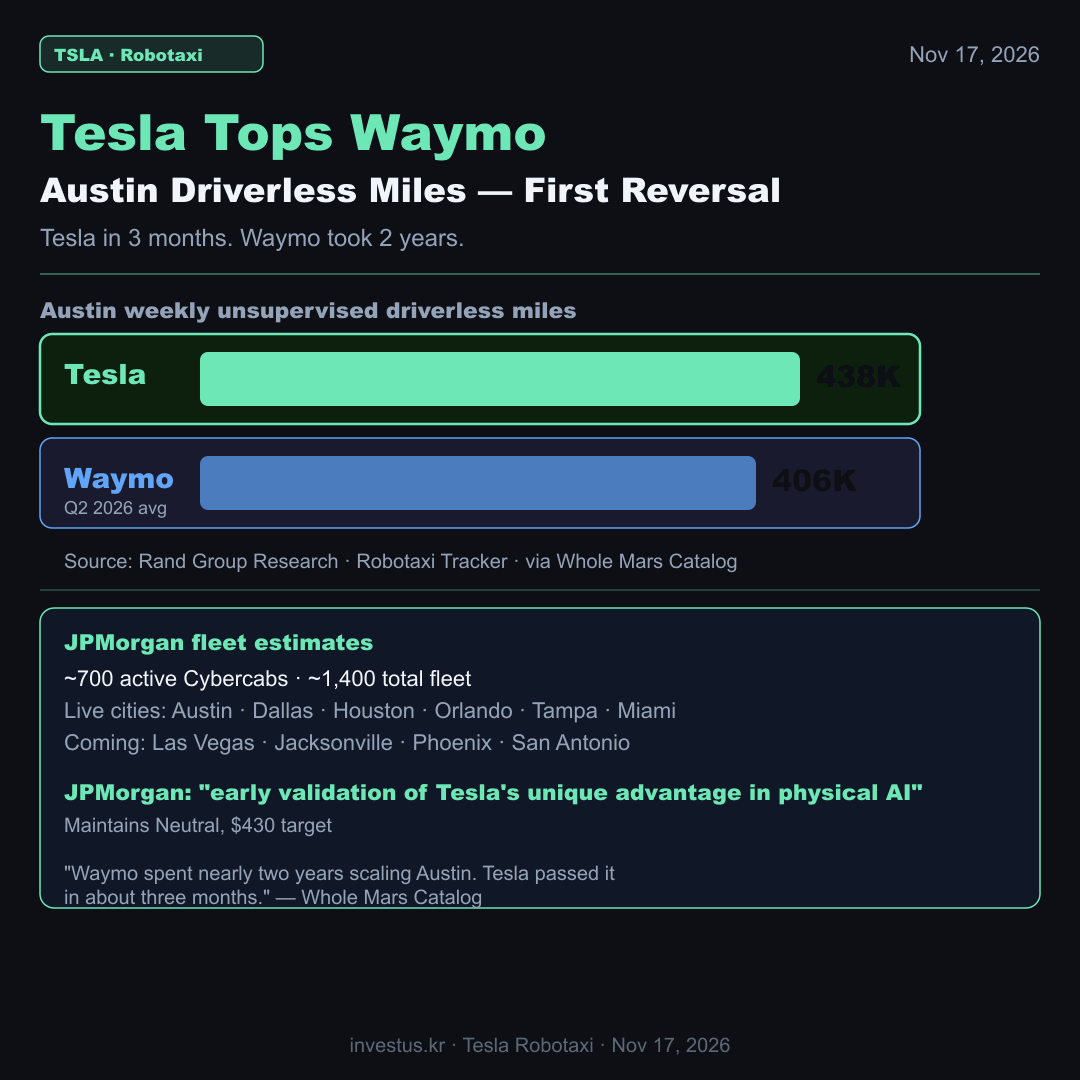
Tesla's Austin driverless miles hit 438,000 per week, exceeding Waymo's Q2 2026 average of 406,000. Waymo took nearly two years to reach that scale in Austin; Tesla did it in roughly three months.
What happened
Rand Group Research data shows Tesla's Austin unsupervised driverless miles reached 438,000 per week, surpassing Waymo's Q2 2026 Austin weekly average of 406,000 for the first time. Whole Mars Catalog: "Waymo spent nearly two years scaling Austin. Tesla passed it in about three months. Preview of what will happen across the rest of the country."
JPMorgan estimates approximately 700 active Cybercabs deployed nationally out of a ~1,400-vehicle fleet. Active cities include Austin, Dallas, Houston, Orlando, Tampa, and Miami.
Architecture determines expansion speed
The reversal is fundamentally an architecture story. Waymo uses vision + lidar + radar multi-modal sensors with city-specific HD mapping. Each new city requires months of pre-mapping work before commercial service can launch. That's why Waymo started in Austin in 2024 and took nearly two years to reach 406K/week at scale.
Tesla's pure-vision FSD operates without pre-built HD maps, allowing geographic expansion at a fundamentally faster pace. Launch preparation compresses from months (Waymo) to weeks (Tesla). That's why Tesla could enter Austin and surpass Waymo's milestone in just three months.
The architectural advantage compounds: as the fleet grows and FSD processes more miles in diverse environments, adaptation to new cities gets faster — a flywheel that accelerates the rollout further. Each new city's launch should be faster than Austin's.
Expansion roadmap and national scale
Tesla is preparing to launch in Las Vegas, Jacksonville, Phoenix, and San Antonio. At the current ramp trajectory, the gap over Waymo could widen significantly by mid-2027.
Whole Mars Catalog's framing — "preview of what will happen across the rest of the country" — is the key thesis here. If Tesla activates most major U.S. cities with Cybercab service by 2027, the competitive dynamics of the robotaxi market shift fundamentally. Waymo's geographic footprint is effectively capped by its mapping requirement; Tesla's is not.
Important caveat: miles don't capture completion rates, disengagement rates, or safety outcomes. Waymo hasn't published Austin-specific safety stats; Tesla's are partial. Miles is the publicly available comparable metric but isn't a complete picture of fleet quality. The reversal in miles is meaningful but should be read alongside safety and reliability data as it becomes available.
Business model and TSLA valuation upside
Tesla's robotaxi business adds a completely new revenue stream on top of vehicle sales, energy, and services. If a single Cybercab operates 10 hours/day at ~$1.50/mile average, annual revenue per vehicle is roughly $50,000. At scale across a large fleet, the revenue potential is substantial relative to Tesla's current annual revenue. This is a multi-year scenario, not near-term, but the Austin weekly miles reversal is the first quantitative data point that starts to make it credible. The market is beginning to price in the robotaxi premium as these numbers come in.
Analyst views
JPMorgan moved to "more constructive" on Tesla's robotaxi opportunity while maintaining Neutral, $430 target. The rapid Cybercab fleet expansion and ride-hailing operations are starting to present "early validation of the company's unique advantage in physical AI." The Austin weekly miles reversal is the first quantitative data point supporting this thesis.
Sources & further reading
Related Guides
Related articles
Tesla research note (2026-11-17)
Tesla Commits €2B More to German Gigafactory, Plans to Hire 10,000 Workers
Tesla is investing an additional €2 billion in its German Gigafactory in Grünheide and plans to hire 10,000 more workers. The move significantly expands European production capacity as Tesla navigates EU tariffs on Chinese imports.
NYT: Musk Dreams of a Conglomerate — What SpaceX-Tesla Merger Means for Tech Supremacy
The New York Times analyzed the SpaceX-Tesla merger scenario under the headline 'Elon Musk Dreams of a Conglomerate.' An analyst told the paper: 'putting SpaceX and Tesla together makes a lot of sense' in an AI economy where computing capacity rules. A $55B Texas chip plant and $119B combined spending are cited as anchors.
Disclaimer
This article is editorial research for informational purposes only. It is not investment advice, a recommendation, or a solicitation to buy or sell any security, and does not guarantee any return. Markets carry risk of loss. Verify figures against the primary sources before making decisions.