
Tesla Commits €2B More to German Gigafactory, Plans to Hire 10,000 Workers
Published · Updated · By Investus editorial desk (SUNRYU Partners)
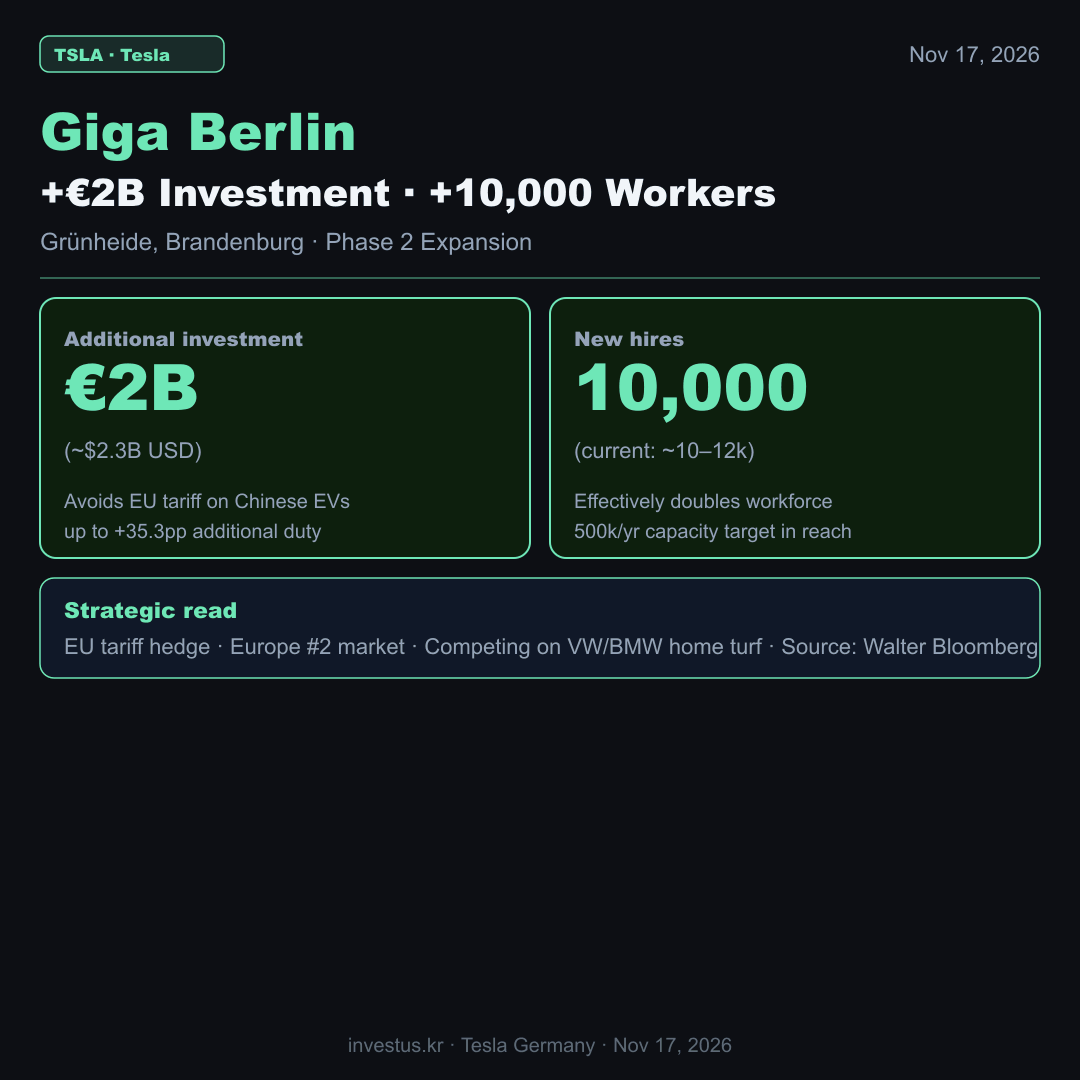
Tesla is investing an additional €2 billion in its German Gigafactory in Grünheide and plans to hire 10,000 more workers. The move significantly expands European production capacity as Tesla navigates EU tariffs on Chinese imports.
What happened
Tesla is investing an additional €2 billion (~$2.3B) into its Gigafactory Berlin-Brandenburg in Grünheide, Germany, and will hire 10,000 new workers, according to Walter Bloomberg. The move represents a major expansion of its European manufacturing footprint.
Giga Berlin launched in 2022 and currently produces the Model Y. After early delays from environmental group opposition and regulatory hurdles, it has been ramping toward a 500,000-unit annual capacity target. This latest investment is a second-wave expansion on top of previously announced capacity additions.
Why local production is essential — the EU tariff logic
Europe is Tesla's second-largest market after North America. Germany is symbolically and competitively critical — home to Volkswagen, BMW, and Mercedes-Benz, it's the heart of the European auto industry.
The EU has imposed up to 35.3 percentage points in additional import tariffs on Chinese-made EVs since late 2024. Model Y units produced at Shanghai Giga and exported to Europe face this tariff directly. By contrast, Giga Berlin-produced Model Y units are sold across the EU tariff-free. Local production isn't optional — it's a price-competitiveness necessity. Without Giga Berlin scaling up, Tesla's ability to compete on price in Europe against Chinese brands and local incumbents erodes significantly.
Scale of the expansion
On staffing: Giga Berlin currently employs approximately 10,000–12,000 workers. Adding another 10,000 is effectively a doubling of the facility's workforce, implying a substantial production ramp beyond the current 500,000/year target. The €2B investment likely reflects plans to push Giga Berlin well above that target over the next few years.
Tesla is simultaneously expanding in Texas, where a ~$55B joint chip manufacturing plant with SpaceX is planned. The parallel European and North American capacity expansions reflect an aggressive long-term manufacturing strategy even as near-term profitability faces pressure. TSLA is down ~13% YTD vs. the S&P 500. Large capex commitments add near-term margin pressure but establish long-term production scale.
Competitive landscape in European EVs
Tesla faces intensifying competition in Europe. BYD is pushing aggressively into the market despite EU tariffs, maintaining price competitiveness through lower manufacturing costs. Local brands — Volkswagen ID series, BMW iX lineup, Renault, Stellantis — are accelerating their EV roadmaps with renewed urgency. In this environment, Giga Berlin's expansion isn't just a capacity growth story — it's a strategic anchor for long-term European market share defense.
Local production also creates secondary benefits: local procurement advantages, regulatory goodwill through job creation in Germany, and supply chain resilience versus pure import exposure. With European regulators increasingly scrutinizing Chinese EVs and American tech giants, being a major German employer carries real political-economy value.
Analyst views
JPMorgan maintains Neutral, $430 target. While noting growing constructiveness on the robotaxi opportunity, the firm estimates ~700 active Cybercabs deployed nationally — Giga Berlin's expansion reinforces the traditional EV business in Europe as a separate but complementary growth vector. The near-term capex overhang is a known headwind; the question is whether the European volume ramp justifies the investment on the timeline Tesla has in mind. Given the tariff environment, most analysts view this as a necessary investment rather than a discretionary one.
Sources & further reading
Related Guides
Related articles
Tesla research note (2026-11-17)
Tesla Robotaxi Passes Waymo in Austin After Just Three Months
Tesla's Austin driverless miles hit 438,000 per week, exceeding Waymo's Q2 2026 average of 406,000. Waymo took nearly two years to reach that scale in Austin; Tesla did it in roughly three months.
NYT: Musk Dreams of a Conglomerate — What SpaceX-Tesla Merger Means for Tech Supremacy
The New York Times analyzed the SpaceX-Tesla merger scenario under the headline 'Elon Musk Dreams of a Conglomerate.' An analyst told the paper: 'putting SpaceX and Tesla together makes a lot of sense' in an AI economy where computing capacity rules. A $55B Texas chip plant and $119B combined spending are cited as anchors.
Disclaimer
This article is editorial research for informational purposes only. It is not investment advice, a recommendation, or a solicitation to buy or sell any security, and does not guarantee any return. Markets carry risk of loss. Verify figures against the primary sources before making decisions.