
Raymond James: SPCX $850 · RKLB $80 Strong Buy — Flight 15 Dual Return Drives Target Raises
Published · Updated · By Investus editorial desk (SUNRYU Partners)
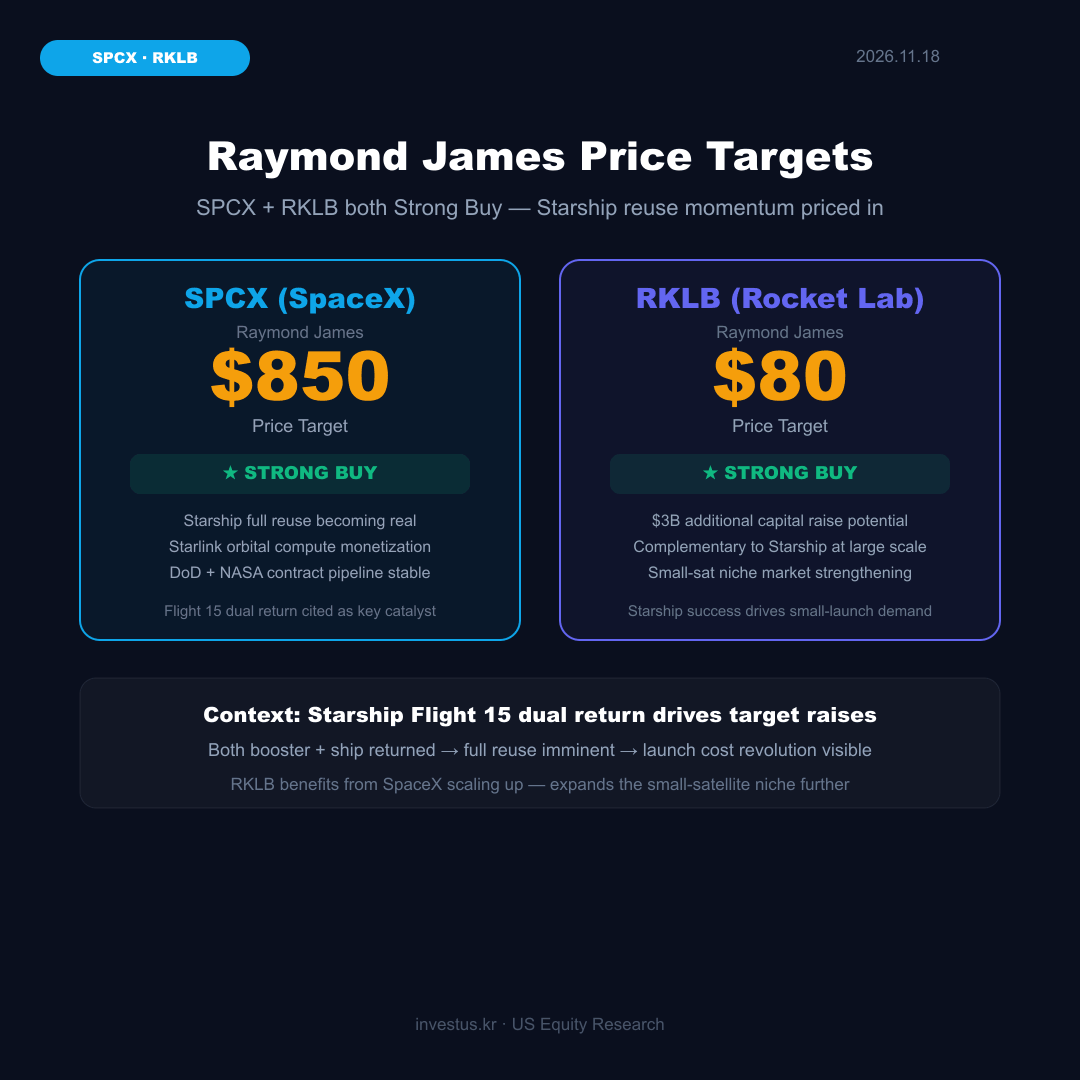
Raymond James issued SPCX $850 and RKLB $80 Strong Buy price targets. Starship Flight 15's historic dual return is the primary catalyst. RKLB benefits from SpaceX scaling to larger missions — expanding the small-satellite niche further.
What happened
Raymond James issued SPCX $850 Strong Buy and RKLB $80 Strong Buy price targets, citing Starship Flight 15's dual return — both Super Heavy and Starship 42 caught at the launch tower — as the primary catalyst for both.
SPCX $850 target — three core reasons
1) Starship full reuse becoming real: Flight 15 dual return makes full reusability a near-term reality. The launch cost revolution moves from theoretical to business case.
2) Starlink orbital compute B2B monetization: SpaceX CFO's 2027–2029 timeline elevates Starlink's valuation ceiling well above a simple satellite broadband provider. The AI infrastructure layer is now reflected in the price target.
3) Stable DoD + NASA contract pipeline: NSSL Phase 3 $985M through 2033 secures the highest-visibility government revenue stream. Artemis HLS ensures NASA contract continuity. Taken together, government revenue predictability supports a valuation premium.
RKLB $80 target — the paradox of SpaceX scaling up
Raymond James' most interesting argument is that Starship's success is net positive for Rocket Lab — not a threat.
The core logic is market segmentation. Starship is a 100-ton class super-heavy-lift vehicle — optimized for large military/commercial satellites, space station modules, and orbital compute constellations. Putting a 50kg small satellite on a 100-ton rocket is economically nonsensical — like chartering a 747 to deliver a single letter.
As SpaceX focuses Starship on large missions, some of the small-to-medium satellite launch demand that Falcon 9 was handling migrates toward dedicated small-launch vehicles like Rocket Lab's Electron (small) and Neutron (medium, in development). The small-launch niche becomes more distinctly defined — and Rocket Lab's competitive position in that niche strengthens.
The $3B additional capital raise potential is also reflected in the target. If Rocket Lab raises the capital to fund Neutron development and manufacturing, it becomes a full-service small-to-medium launch provider — a broader moat.
Rocket Lab fundamentals
Electron has 95%+ launch success rate with 50+ flights. Rocket Lab also manufactures satellite buses (Photon) and runs a space systems solutions business — vertically integrating the small satellite supply chain.
Neutron (targeting 8 tons to LEO at ~$55M/launch) would compete with Falcon 9 ($70M–$100M). Development completion and first launch is the medium-term key catalyst. If Neutron succeeds, RKLB's total addressable market expands significantly.
SpaceX and Rocket Lab as complements
The SpaceX-Rocket Lab dynamic resembles TSMC vs. specialty foundries in semiconductors. As TSMC pushes to leading-edge nodes (2nm, 3nm), specialty mature-node foundries (28nm, 40nm specialists) see their competitive position strengthen — not weaken. As SpaceX scales to ever-larger missions, dedicated small-launch vehicles gain pricing power in their niche market.
The space economy's total addressable market is expanding simultaneously with launch specialization. Both SpaceX and Rocket Lab can grow in a world where the pie gets bigger and each player focuses on their optimal payload size range.
Analyst consensus
Beyond Raymond James: Citi has SPCX at $280; Wall St Engine implies 905%+ upside. RKLB is receiving increasing institutional attention alongside the small-satellite market growth thesis. Raymond James' simultaneous Strong Buy on both stocks reflects emerging consensus that the orbital economy is entering a structural growth phase — and both the dominant large-launch and best-in-class small-launch providers are well-positioned within it.
Sources & further reading
Related Guides
Related articles
Nov 18 — Orbital Compute Roadmap · $985M DoD Contract · TSLA Institutions Record · Powercore · Smart Money · SPCX $850 Target
SpaceX CFO revealed a 2027–2029 orbital compute roadmap and secured a $985M Air Force contract. Tesla hit record institutional ownership and unveiled Powercore. Druckenmiller and Burry loaded SPCX. Raymond James issued SPCX $850 / RKLB $80 Strong Buy targets.
SpaceX CFO Reveals Orbital Compute Roadmap: 2027 First Sats, 2029 GW-Scale Operations
SpaceX CFO Bret Johnsen revealed a concrete 3-year orbital compute timeline: first satellites in 2027, constellation scaling in 2028, and GW-scale compute operating in space by 2029. Flight 15 achieved a historic dual return — both Super Heavy and Starship caught at the tower.
SpaceX Wins $985M US Air Force NSSL Phase 3 Contract Through 2033
The DoD awarded National Security Space Launch (NSSL) Phase 3 Lane 2 contracts to SpaceX, ULA, and Blue Origin. Combined ceiling: $985M through April 2033. SpaceX secures one of its highest-visibility government revenue streams.
Disclaimer
This article is editorial research for informational purposes only. It is not investment advice, a recommendation, or a solicitation to buy or sell any security, and does not guarantee any return. Markets carry risk of loss. Verify figures against the primary sources before making decisions.