
SpaceX Wins $985M US Air Force NSSL Phase 3 Contract Through 2033
Published · Updated · By Investus editorial desk (SUNRYU Partners)
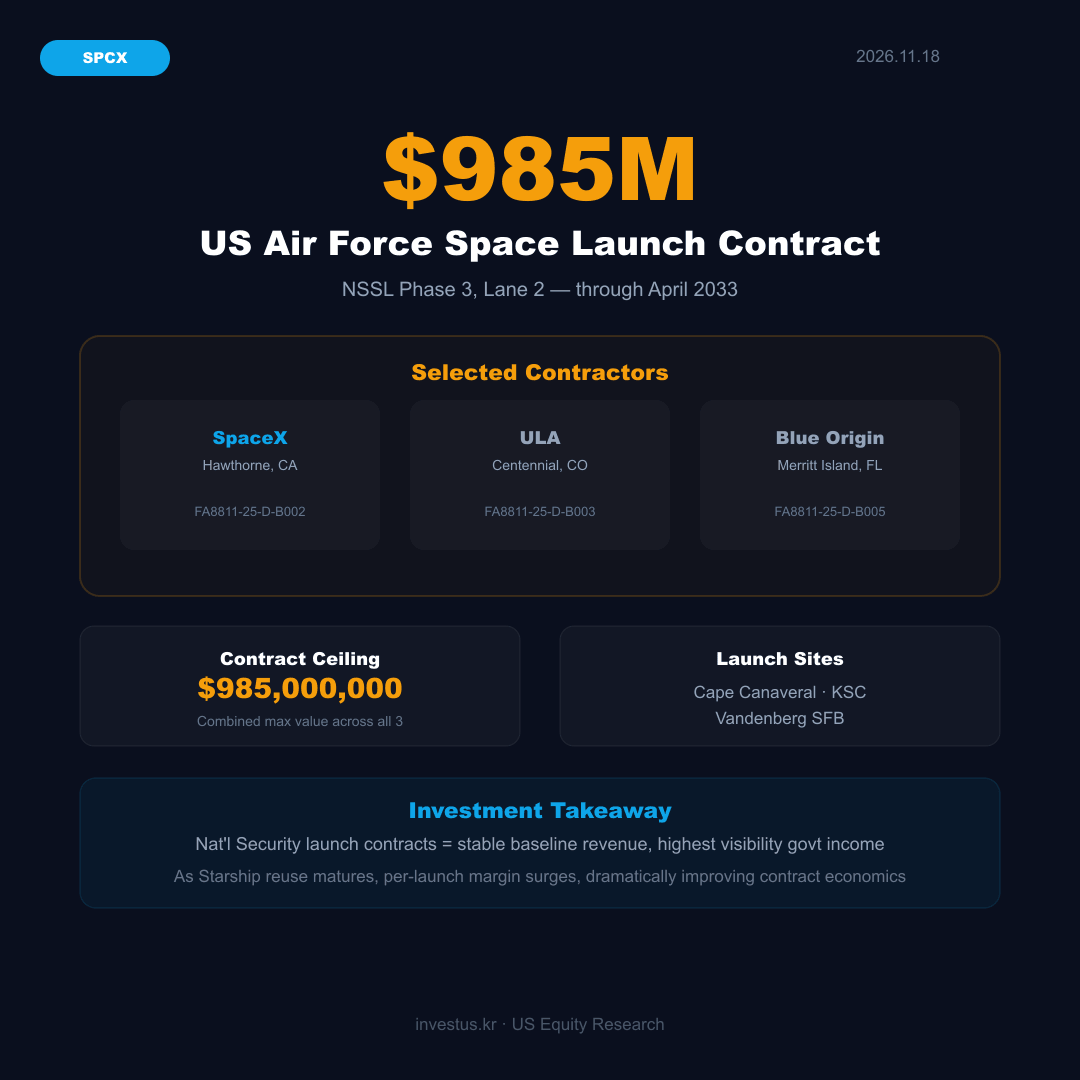
The DoD awarded National Security Space Launch (NSSL) Phase 3 Lane 2 contracts to SpaceX, ULA, and Blue Origin. Combined ceiling: $985M through April 2033. SpaceX secures one of its highest-visibility government revenue streams.
What happened
The US Department of Defense announced in its November 16, 2026 contract release that NSSL (National Security Space Launch) Phase 3 Lane 2 contracts were awarded to SpaceX, United Launch Services (ULA), and Blue Origin. SpaceX (Hawthorne, CA) received contract FA8811-25-D-B002 (modification P00006). Combined contract ceiling: $985,000,000. Launch sites: Cape Canaveral/KSC (Florida) and Vandenberg SFB (California). Contract runs through April 2033.
What is NSSL?
NSSL is the US Space Force's program to launch high-value national security payloads — GPS satellites, military communications, reconnaissance. These are America's most critical orbital assets. The program is structurally insulated from foreign competition; only US launch vehicles are eligible. That makes it a near-monopoly environment for the selected providers, with minimal price competition and no foreign bidders.
In Phase 1 and 2, ULA (Atlas V, Delta IV) dominated NSSL. Phase 3 brought SpaceX and Blue Origin into competition. SpaceX already captured ~40% of Phase 2 missions; Falcon 9 and Falcon Heavy's proven track record positioned SpaceX for a larger Phase 3 share.
Contract details
Selected contractors: SpaceX (Hawthorne, CA · FA8811-25-D-B002), ULA (Centennial, CO), Blue Origin (Merritt Island, FL · FA8811-25-D-B005). The $985M ceiling is a combined maximum across all three; individual mission awards are competitively bid. Lane 2 covers heavy-lift missions — Falcon Heavy, New Glenn, and potentially future Starship missions. The 7-year duration provides multi-year revenue visibility for all three providers.
Why it matters — SpaceX revenue structure
Commercial satellite launch is price-competitive (SpaceX vs Chinese rockets vs Ariane 6). NSSL is not — it's US-only by law, and the DoD's highest-value payloads command premium pricing with minimal downward pressure. For SpaceX, NSSL is the highest-visibility government revenue stream after Starlink. SpaceX's estimated ~$13B annual revenue includes substantial government contract revenue from NASA and DoD. NSSL Phase 3 through 2033 significantly increases revenue predictability for the government segment.
The more important dynamic: Starship full reuse improves contract economics dramatically. Current Falcon 9 internal launch cost estimates range from $15M–$30M. Starship fully recovered: theoretical $1M fuel cost for 100 tons. If NSSL mission pricing holds while launch costs fall, per-mission margins improve structurally. That's the medium-term story.
Competitive dynamics
ULA is transitioning from Atlas V (retired) to Vulcan Centaur for Phase 3. Blue Origin enters NSSL Lane 2 for the first time with New Glenn — maintaining launch success rate is critical to contract retention. SpaceX leverages Falcon 9's industry-leading reliability and Falcon Heavy's payload capacity.
If Starship is eventually certified for NSSL, its 100-ton payload capability opens missions impossible with current vehicles. With next-generation military satellite platforms trending larger, Starship's potential NSSL entry is a medium-term market share expander for SpaceX in national security launch.
Analyst views
Raymond James cited 'stable DoD + NASA launch contract pipeline' as one of three core reasons for its SPCX $850 Strong Buy target. The long-term contract duration and government revenue predictability provide a stability premium in SpaceX's valuation. Combined with the Starship reuse margin improvement thesis, NSSL Phase 3 is a key driver of SpaceX's medium-term profitability improvement.
Sources & further reading
Related Guides
Related articles
Nov 18 — Orbital Compute Roadmap · $985M DoD Contract · TSLA Institutions Record · Powercore · Smart Money · SPCX $850 Target
SpaceX CFO revealed a 2027–2029 orbital compute roadmap and secured a $985M Air Force contract. Tesla hit record institutional ownership and unveiled Powercore. Druckenmiller and Burry loaded SPCX. Raymond James issued SPCX $850 / RKLB $80 Strong Buy targets.
SpaceX CFO Reveals Orbital Compute Roadmap: 2027 First Sats, 2029 GW-Scale Operations
SpaceX CFO Bret Johnsen revealed a concrete 3-year orbital compute timeline: first satellites in 2027, constellation scaling in 2028, and GW-scale compute operating in space by 2029. Flight 15 achieved a historic dual return — both Super Heavy and Starship caught at the tower.
Druckenmiller $30M New + Burry 40.7% Portfolio — Smart Money Makes High-Conviction SpaceX Bets
Stanley Druckenmiller's Duquesne Family Office entered SpaceX with $30M new in Q3 2026. Michael Burry's Scion has 40.7% of its portfolio in SPCX (+6% added), the largest position. The most sophisticated investors are making concentrated bets on orbital compute and Starlink momentum.
Disclaimer
This article is editorial research for informational purposes only. It is not investment advice, a recommendation, or a solicitation to buy or sell any security, and does not guarantee any return. Markets carry risk of loss. Verify figures against the primary sources before making decisions.