
SpaceX CFO Reveals Orbital Compute Roadmap: 2027 First Sats, 2029 GW-Scale Operations
Published · Updated · By Investus editorial desk (SUNRYU Partners)
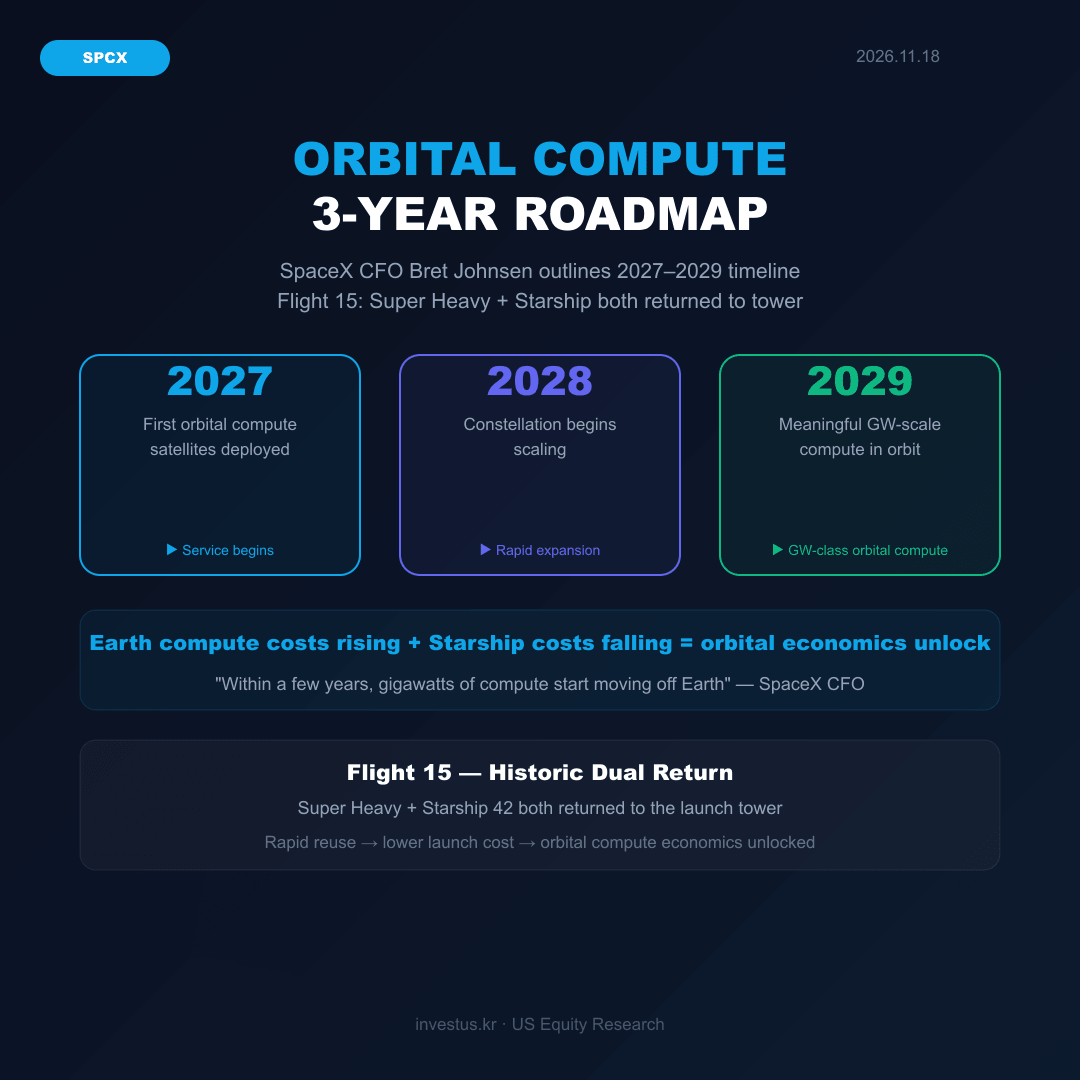
SpaceX CFO Bret Johnsen revealed a concrete 3-year orbital compute timeline: first satellites in 2027, constellation scaling in 2028, and GW-scale compute operating in space by 2029. Flight 15 achieved a historic dual return — both Super Heavy and Starship caught at the tower.
What happened
SpaceX CFO Bret Johnsen publicly disclosed a 3-year orbital compute roadmap for the first time: first orbital compute satellites deployed in 2027, constellation scaling in 2028, and meaningful GW-scale compute operating in space by 2029. The significance: a CFO issuing this timeline means it's a business plan, not an engineering vision.
On the same day, Starship Flight 15 concluded successfully. Both Super Heavy and Starship 42 were caught by the Mechazilla tower at Starbase — the first time both stages returned to the launch tower in a single flight. This dual return directly validates the prerequisite for orbital compute economics: dramatically lower launch costs through rapid full reuse.
What is orbital compute?
Orbital compute means running AI training, inference, and data-processing workloads on satellites in space rather than on the ground. The CFO's core thesis is clean: earth-side compute costs are rising due to AI demand, while Starship reuse is driving launch costs down. Where those two curves cross, orbital compute becomes economically viable.
'Within a few years, gigawatts of compute start moving off Earth' is not a hypothetical — it's a business timeline statement. With AI data center power consumption becoming a top-tier US grid challenge, the unlimited solar energy and natural cooling of orbital space positions it as the next frontier for compute infrastructure.
2027–2029 roadmap details
2027: First orbital compute satellites deployed. This is a proof-of-concept and early B2B contract phase. The Starlink V3 platform is likely the base — adding a compute layer on top of existing Starlink infrastructure.
2028: Constellation begins scaling. Satellite count grows rapidly; orbital compute capacity reaches meaningful levels. Economically feasible only with Starship full reuse costs — which Flight 15 is now validating.
2029: 'Meaningful amounts of compute operating in space' — GW-scale target. With AI data centers now consuming hundreds of MW to GW at scale, GW-class orbital compute could become a significant component of AI infrastructure within this window.
Flight 15 and the prerequisite
Flight 15's dual return is the prerequisite materializing. With both stages recovered, the theoretical $1M fuel cost for 100 tons to orbit comes into reach — roughly $10/kg versus Falcon 9's $1,500–$2,700/kg. The economics for deploying large compute satellites changes completely at that cost level. SpaceX currently runs 50+ Falcon 9 launches annually plus an increasing Starship cadence.
Competitive landscape
Against Amazon's Project Kuiper, OneWeb, and China's SpaceSail in satellite internet, SpaceX's orbital compute is a differentiation strategy beyond basic connectivity. Satellites that run AI inference at the edge are not communication nodes — they're distributed compute infrastructure. If realized, Starlink's valuation ceiling expands dramatically beyond a simple broadband provider. Starlink revenue is currently estimated at ~$12B annually; orbital compute B2B services could add substantial high-margin revenue by 2029–2030.
Analyst views
Raymond James issued SPCX $850 Strong Buy, citing Flight 15 dual return and the orbital compute roadmap as primary catalysts. The bull case rests on Starship full reuse becoming real, Starlink orbital compute B2B monetization, and stable DoD/NASA contract pipeline. Citi previously raised to $280 after earlier Flight 15 milestones. Today's CFO-level timeline disclosure is the most concrete forward guidance SpaceX has issued on orbital compute to date.
Sources & further reading
Related Guides
Related articles
Nov 18 — Orbital Compute Roadmap · $985M DoD Contract · TSLA Institutions Record · Powercore · Smart Money · SPCX $850 Target
SpaceX CFO revealed a 2027–2029 orbital compute roadmap and secured a $985M Air Force contract. Tesla hit record institutional ownership and unveiled Powercore. Druckenmiller and Burry loaded SPCX. Raymond James issued SPCX $850 / RKLB $80 Strong Buy targets.
SpaceX Wins $985M US Air Force NSSL Phase 3 Contract Through 2033
The DoD awarded National Security Space Launch (NSSL) Phase 3 Lane 2 contracts to SpaceX, ULA, and Blue Origin. Combined ceiling: $985M through April 2033. SpaceX secures one of its highest-visibility government revenue streams.
Druckenmiller $30M New + Burry 40.7% Portfolio — Smart Money Makes High-Conviction SpaceX Bets
Stanley Druckenmiller's Duquesne Family Office entered SpaceX with $30M new in Q3 2026. Michael Burry's Scion has 40.7% of its portfolio in SPCX (+6% added), the largest position. The most sophisticated investors are making concentrated bets on orbital compute and Starlink momentum.
Disclaimer
This article is editorial research for informational purposes only. It is not investment advice, a recommendation, or a solicitation to buy or sell any security, and does not guarantee any return. Markets carry risk of loss. Verify figures against the primary sources before making decisions.