
Starship Flight 16 & 17 Mission Plan: Starlink V3, Kenneli Cargo, and Starbase Supply
Published · Updated · By Investus editorial desk (SUNRYU Partners)
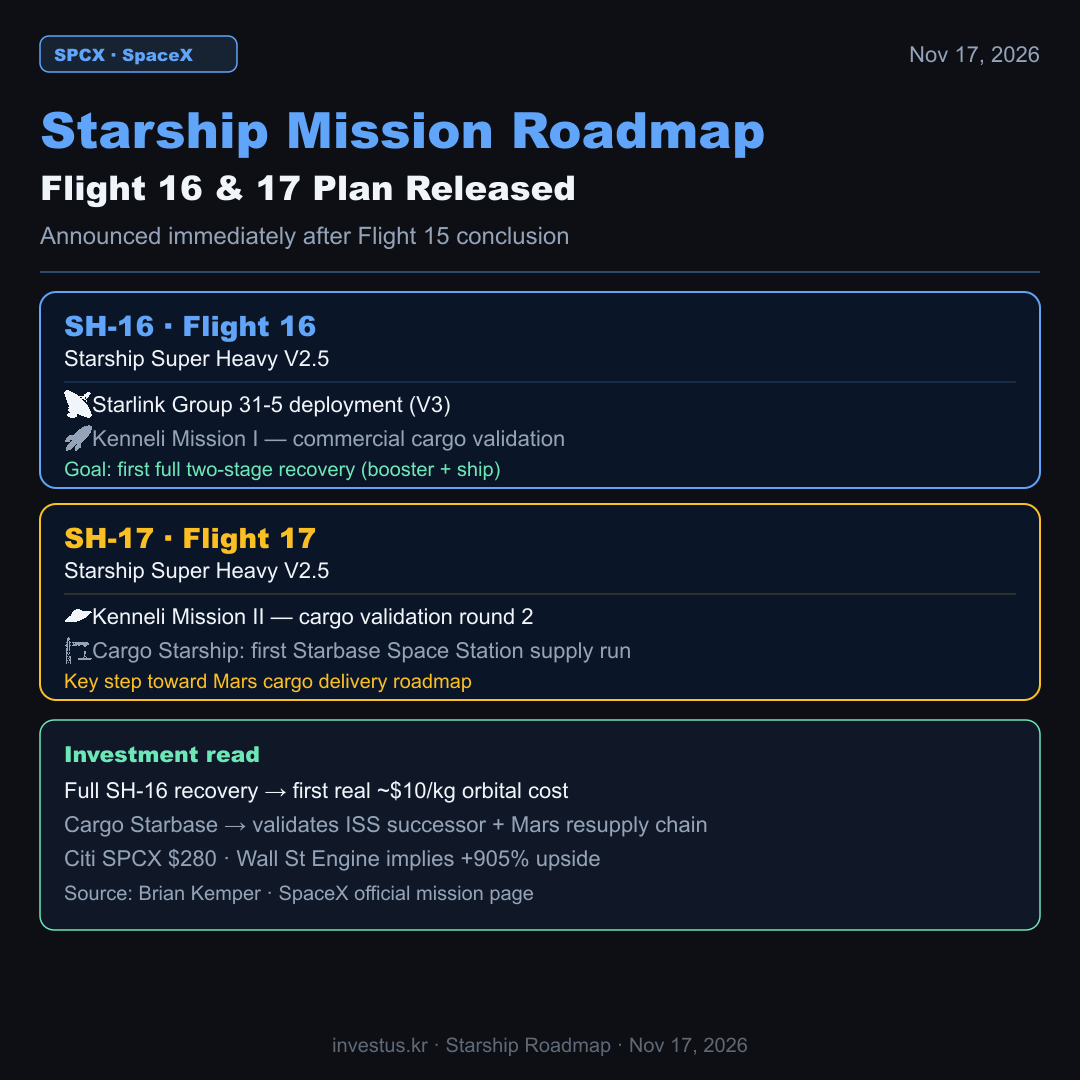
SpaceX released the upcoming Starship mission roadmap following Flight 15. Flight 16 targets Starlink Group 31-5 and Kenneli Mission I; Flight 17 covers Kenneli Mission II and the first Cargo Starship supply run to Starbase Space Station.
What happened
SpaceX released the upcoming Starship mission schedule immediately after Flight 15's conclusion. The 2026 roadmap:
Flight 16 (SH-16, Starship Super Heavy V2.5):
- Starlink Group 31-5 satellite deployment
- Kenneli Mission I (commercial cargo validation)
Flight 17 (SH-17, Starship Super Heavy V2.5):
- Kenneli Mission II
- Cargo Starship: Starbase Space Station supply run
What the Kenneli missions are
The Kenneli missions are a two-step commercial cargo validation program. Kenneli I on SH-16, Kenneli II on SH-17. These demonstrate Starship's ability to deliver commercial payloads on a reusable basis. The specific cargo type and customer for the Kenneli missions haven't been publicly disclosed, but possibilities include satellite clusters, large structural modules, or components for private space stations.
Successful completion of Kenneli I and II would signal that Starship has achieved commercial launch service reliability — not just for government contracts but for private commercial customers seeking heavy-lift capability at Starship's dramatically lower cost per kg. This is the milestone that opens Starship as a revenue-generating commercial service rather than a test program.
Why the Cargo Starbase mission matters
The Cargo Starbase mission is proof-of-concept for orbital station resupply using Starship. SpaceX's long-term plan involves Starship as the backbone of ISS successor resupply and eventually Mars cargo delivery. This mission is a key step on that roadmap.
Currently, ISS resupply contracts are held by SpaceX (Dragon capsule) and Northrop Grumman (Cygnus). A successful Cargo Starbase Starship mission positions SpaceX to win the next generation of station resupply contracts — including those for private stations from Axiom Space, Vast, and others — at Starship's dramatically lower cost per kg. These contracts represent hundreds of millions annually in potential new revenue. Longer-term, the Cargo Starship capability is a prerequisite for the Mars surface supply missions that underpin SpaceX's most ambitious long-term plans.
Starlink V3 deployment and Flight 16 full recovery goal
Starlink Group 31-5 adds more V3 satellites to SpaceX's ~7,000-satellite constellation. V3 satellites are heavier and higher-throughput than V2, critical for expanding aviation and maritime B2B services — both high-margin segments driving SPCX revenue growth. If V3 aviation terminals begin mass adoption in 2027 as expected, Starlink's B2B revenue trajectory could significantly exceed current estimates.
SpaceX has also set full two-stage recovery (booster + ship) as a Flight 16 objective. If achieved, it would be the first time the theoretical $1M/100-ton orbital cost becomes a demonstrated reality rather than a projection. That single event would structurally lower Starlink V3 deployment costs and fundamentally improve SpaceX's margin structure — the most consequential near-term milestone in SpaceX's business trajectory.
Analyst views
Wall St Engine has a price target implying +905% upside for SpaceX. Citi raised its target to $280 post Flight 15. Sequential execution of the Starship mission roadmap is the primary driver of near-term SpaceX valuation upside. If Kenneli missions and Cargo Starbase both succeed on SH-16 and SH-17, it establishes new revenue models in both commercial launch and orbital logistics — a step-change in SPCX's business visibility that the current price may not yet fully reflect.
Sources & further reading
Related Guides
Related articles
Tesla research note (2026-11-17)
Starship Full Recovery Economics: $1M Fuel Cost to Deliver 100 Tons to Orbit
SpaceX concluded Flight 15 with the catch of Ship 42 at Starbase. With both booster and ship recovered, analysts estimate the cost to put 100 tons into orbit at just $1M in fuel — roughly 1/150th of Falcon 9. A new era for orbital economics.
NYT: Musk Dreams of a Conglomerate — What SpaceX-Tesla Merger Means for Tech Supremacy
The New York Times analyzed the SpaceX-Tesla merger scenario under the headline 'Elon Musk Dreams of a Conglomerate.' An analyst told the paper: 'putting SpaceX and Tesla together makes a lot of sense' in an AI economy where computing capacity rules. A $55B Texas chip plant and $119B combined spending are cited as anchors.
Disclaimer
This article is editorial research for informational purposes only. It is not investment advice, a recommendation, or a solicitation to buy or sell any security, and does not guarantee any return. Markets carry risk of loss. Verify figures against the primary sources before making decisions.