
Starship Full Recovery Economics: $1M Fuel Cost to Deliver 100 Tons to Orbit
Published · Updated · By Investus editorial desk (SUNRYU Partners)
SpaceX concluded Flight 15 with the catch of Ship 42 at Starbase. With both booster and ship recovered, analysts estimate the cost to put 100 tons into orbit at just $1M in fuel — roughly 1/150th of Falcon 9. A new era for orbital economics.
What happened
SpaceX's Starship Flight 15 concluded with the Mechazilla tower catch of Ship 42. Astrophotographer John Kraus confirmed: "SHIP CATCH: SpaceX has caught Starship 42 at Starbase to conclude Flight 15! A historic moment in humanity's journey to explore the stars."
The Super Heavy booster was lost on Flight 15, but the Ship recovery alone is a significant milestone. SpaceX is now preparing subsequent flights targeting full two-stage recovery.
The orbital economics shift — a historic cost compression
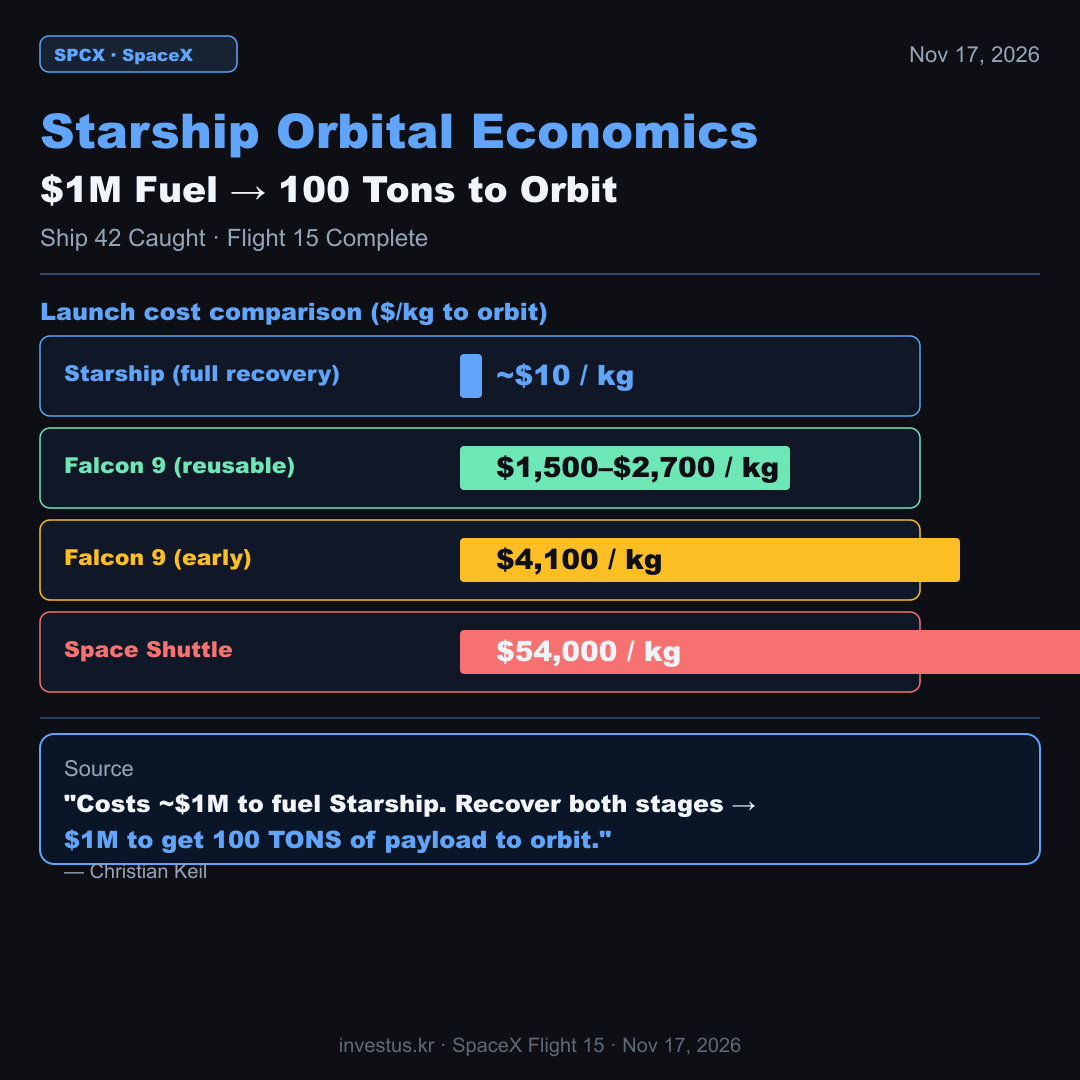
Space analyst Christian Keil broke down the numbers: "It costs about $1 million to fuel Starship. If they recover both the ship and the booster, that's their cost to get 100 TONS of payload to orbit. Unreal. New era in space exploration."
$1M for 100 tons = ~$10/kg to orbit. For comparison:
- Space Shuttle: ~$54,000/kg
- Early Falcon 9: ~$4,100/kg
- Current reusable Falcon 9: ~$1,500–$2,700/kg
- Starship (both stages recovered): ~$10/kg (theoretical)
This isn't just a marginal improvement — it's a 150x reduction versus current Falcon 9 costs and a 5,400x reduction versus the Space Shuttle. For perspective: the entire mass of the International Space Station (~420 metric tons) could theoretically be resupplied in just a few Starship missions at this cost level, versus what it cost historically using Shuttle-era infrastructure.
Starlink V3 and commercial space implications
The implications for Starlink V3 are significant. Heavier, higher-throughput V3 satellites can be deployed at dramatically lower cost per kg once full reusability is routine. SpaceX currently operates ~7,000 Starlink satellites and is transitioning to V3 — the deployment cadence accelerates as launch costs fall. If V3 aviation terminals begin mass adoption in 2027 as expected, Starlink's B2B revenue trajectory could significantly exceed current estimates.
NASA Administrator Janet Napolitano called the Ship 42 catch "a true GAME CHANGER." With NASA's Artemis III lunar landing depending on a Starship lander variant, full reusability fundamentally changes the cost structure for the government's deep-space program. The contract value and strategic importance of Starship HLS (Human Landing System) grow further as this cost trajectory becomes credible.
Flight 16 will attempt full two-stage recovery for the first time. After losing the booster on Flight 15, SpaceX has refined the booster catch mechanics. If successful, the theoretical $10/kg cost becomes a demonstrated reality — a watershed moment for the commercial launch industry.
Competitive landscape
At $10/kg versus competitors' $1,500–$7,500/kg range, the competitive gap becomes structurally insurmountable for other providers. The knock-on effect for Starlink B2B is substantial: aviation and maritime terminal adoption accelerates when V3 deployment costs fall. The commercial cargo station resupply market (ISS successors from Axiom Space, Vast, etc.) also opens up as Cargo Starship missions prove out. SpaceX currently holds ISS resupply contracts via Dragon; next-generation Starship-based resupply could represent hundreds of millions annually in new contract value.
Analyst views
Citi raised its SpaceX (SPCX) price target from $240 to $280. The Ship 42 catch brings full two-stage recovery into realistic range, with positive implications for Starlink V3 deployment cadence and Artemis contract continuity. Wall St Engine has an SPCX price target implying +905% upside from current levels.
Sources & further reading
Related Guides
Related articles
Tesla research note (2026-11-17)
NYT: Musk Dreams of a Conglomerate — What SpaceX-Tesla Merger Means for Tech Supremacy
The New York Times analyzed the SpaceX-Tesla merger scenario under the headline 'Elon Musk Dreams of a Conglomerate.' An analyst told the paper: 'putting SpaceX and Tesla together makes a lot of sense' in an AI economy where computing capacity rules. A $55B Texas chip plant and $119B combined spending are cited as anchors.
Starship Flight 16 & 17 Mission Plan: Starlink V3, Kenneli Cargo, and Starbase Supply
SpaceX released the upcoming Starship mission roadmap following Flight 15. Flight 16 targets Starlink Group 31-5 and Kenneli Mission I; Flight 17 covers Kenneli Mission II and the first Cargo Starship supply run to Starbase Space Station.
Disclaimer
This article is editorial research for informational purposes only. It is not investment advice, a recommendation, or a solicitation to buy or sell any security, and does not guarantee any return. Markets carry risk of loss. Verify figures against the primary sources before making decisions.