
Market Crash Special — Why AI Stocks Collapsed Today: 5 Compounding Factors
Published · Updated · By Investus editorial desk (SUNRYU Partners)
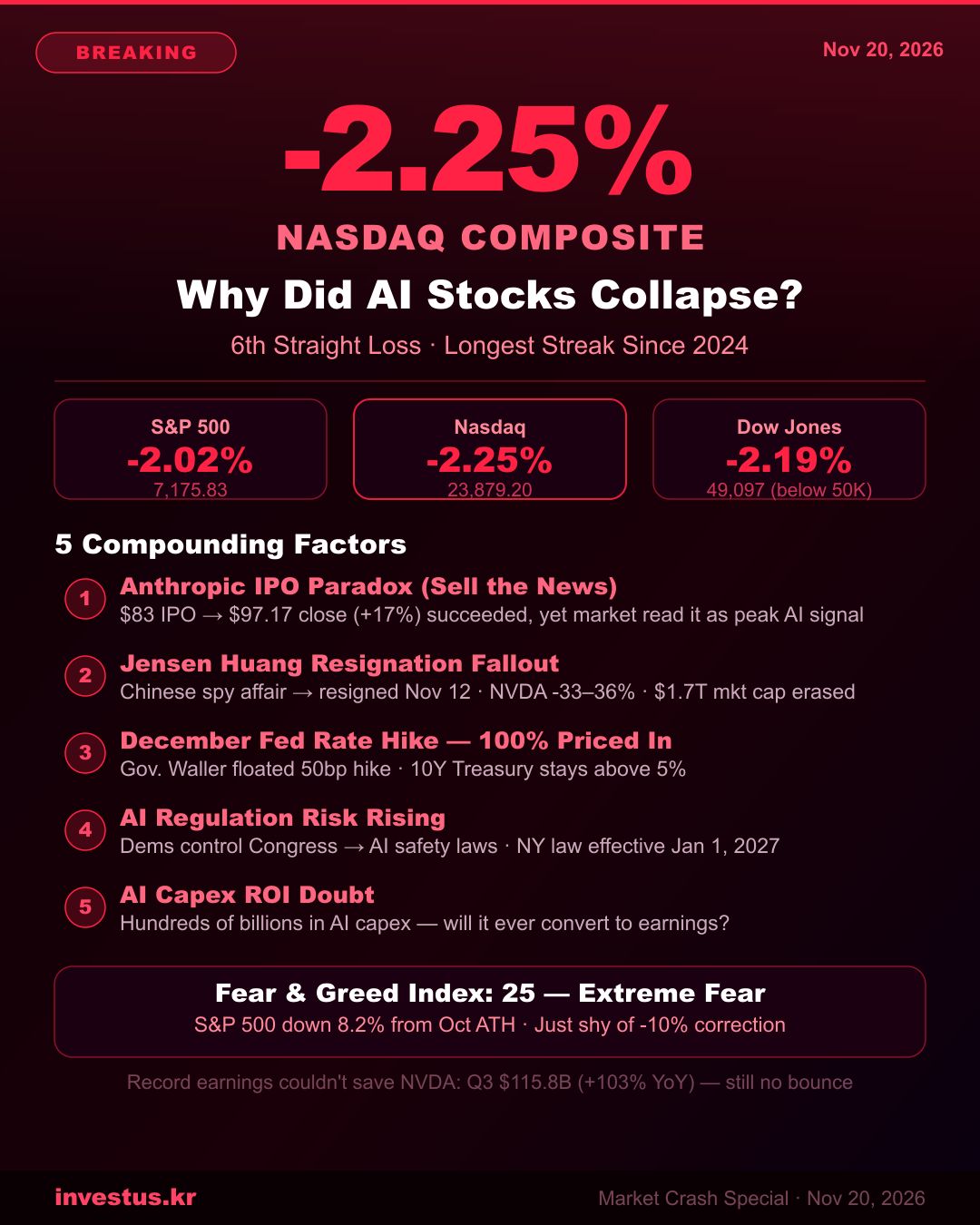
Nov 19: S&P 500 -2.02% → 7,175.83, Nasdaq -2.25% → 23,879.20, Dow -1,101pts → 49,097.06, breaking below 50,000. Sixth straight day of losses — longest streak since 2024. Anthropic's record IPO failed to revive AI enthusiasm; Jensen Huang resignation, 100% Dec rate hike odds, AI capex ROI fears, and AI regulation anxiety all compounded.
What Happened
US markets fell sharply on Thursday, November 19. The S&P 500 lost 2.02% to close at 7,175.83, marking its sixth consecutive losing session — the longest losing streak since 2024. The Nasdaq fell 2.25% (−550 points) to 23,879.20, and the Dow Jones Industrial Average dropped 1,101 points (2.19%) to 49,097.06, breaking below 50,000 for the first time since June. 464 of 500 S&P 500 stocks declined, all 11 sectors closed lower. The index is now down 8.2% from its October all-time high, just shy of a formal 10% correction.
Early in the session, Anthropic — the largest AI company IPO on record — opened at $111.50 (up 35% from its $83 offering price), fueling hopes for an AI-led rebound. But the moment Anthropic started trading on Nasdaq, markets reversed sharply lower. Anthropic closed at $97.17 (+17%) with a $1.76T market cap — a successful debut — while the broader market collapsed around it.
The Five Compounding Factors
1. The Anthropic IPO paradox. The largest-ever AI IPO succeeded, yet markets fell harder. The market message was clear: "Demand to invest in AI exists, but uncertainty about whether that investment translates to earnings does not." Some analysts read the sell-the-news reaction as a signal that the AI trade is approaching its peak.
2. The Jensen Huang resignation fallout continues. NVIDIA co-founder and CEO Jensen Huang acknowledged multiple extramarital affairs on November 8 — including one with a woman suspected of ties to Chinese intelligence — and resigned as CEO and board member effective immediately on November 12. CFO Colette Kress became interim CEO; the board ruled out reinstating Huang. NVDA has fallen 33–36% from its October peak, erasing approximately $1.7 trillion in market cap. Despite reporting record Q3 FY27 revenue of $115.8B (+103% YoY), the stock cannot recover — signaling just how deep the leadership-vacuum anxiety runs.
3. December Fed rate hike at 100% probability. CME's FedWatch tool has priced in a December hike at 100%. Fed Governor Christopher Waller stated a 50bp rate hike could be warranted. The 10-year Treasury yield remains above 5%, pressuring the valuations of high-multiple tech stocks.
4. AI regulation risk. Democrats took control of Congress in the November 3 midterms, raising the prospect of AI regulation legislation. New York's AI safety law takes effect January 1, 2027, requiring frontier AI developers including OpenAI and Anthropic to register and meet reporting requirements. The disclosure that Anthropic donated $40M to pro-AI-safety political groups added political risk to the AI sector.
5. AI capex ROI doubt. Meta, Amazon, Google, and Microsoft are spending hundreds of billions on AI chips and data centers, but uncertainty around whether that capex converts to earnings continues to grow. The Fear & Greed Index sits at 25 (Extreme Fear).
What Wall Street Is Saying
Goldman Sachs and Morgan Stanley characterize the current selloff as a valuation reset. Goldman maintains a year-end S&P 500 target of 7,500 but leaves room for a downward revision if the December FOMC delivers a 50bp hike. Morgan Stanley expects the AI-trade cyclical correction to wrap up within one to two quarters and identifies Q1 next year — when Blackwell GPU shipments ramp — as a potential re-entry opportunity.
NVDA interim CEO Colette Kress repeatedly said "We've got this" during the Q3 earnings call, attempting to restore investor confidence. Historically, Extreme Fear readings (sub-25) have overlapped with medium-to-long-term buying opportunities — but given the concurrent rate and AI-governance uncertainty, this environment calls for careful fundamental selection rather than a blanket buy-the-dip trade.
Chart
Open NVIDIA on TradingView.
Sources & further reading
Related Guides
Related articles
NVDA: ~$1T Cumulative Free Cash Flow in 3 Years — CAGR 58.2%
NVIDIA's free cash flow is projected to total approximately $1 trillion over the next three years: Jan'27(E) $190B, Jan'28(E) $327B, Jan'29(E) $452B — CAGR 58.2%. Since 2018, NVDA's FCF has changed +15,427%. The LTM figure is $127B; the Jan'29 estimate is 3.5× that level.
NVDA — Commerce Dept OKs China AI Chip Sales, Including Sanctioned Firms
The US Commerce Department has reportedly been approving NVIDIA GPU and chip sales to Chinese companies including those that did not exist on paper, those on the sanctions list, and those with ties to the Chinese military. The paradoxical reversal could be a short-term NVDA catalyst but carries political and diplomatic backlash risk.
Daily Snapshot 2026.07.15 — IBM Earnings Shock + Top 9
BREAKING IBM Q2 miss −28% · CPI −0.4% · Chamath TSLA~$600 · Robotaxi 765 · GOOGL 1.6GW · TSMC $140B · JPM $16.9B · NFLX $169 · SNDK $3,100 · LCID −41.74%. More in individual reports.
Disclaimer
This article is editorial research for informational purposes only. It is not investment advice, a recommendation, or a solicitation to buy or sell any security, and does not guarantee any return. Markets carry risk of loss. Verify figures against the primary sources before making decisions.