
BigTech Earnings Week Preview — MSFT & GOOGL Oct 28 · AMZN Oct 29 · $725B AI capex check · TSLA-SPCX merger watch
Published · Updated · By Investus editorial desk (SUNRYU Partners)
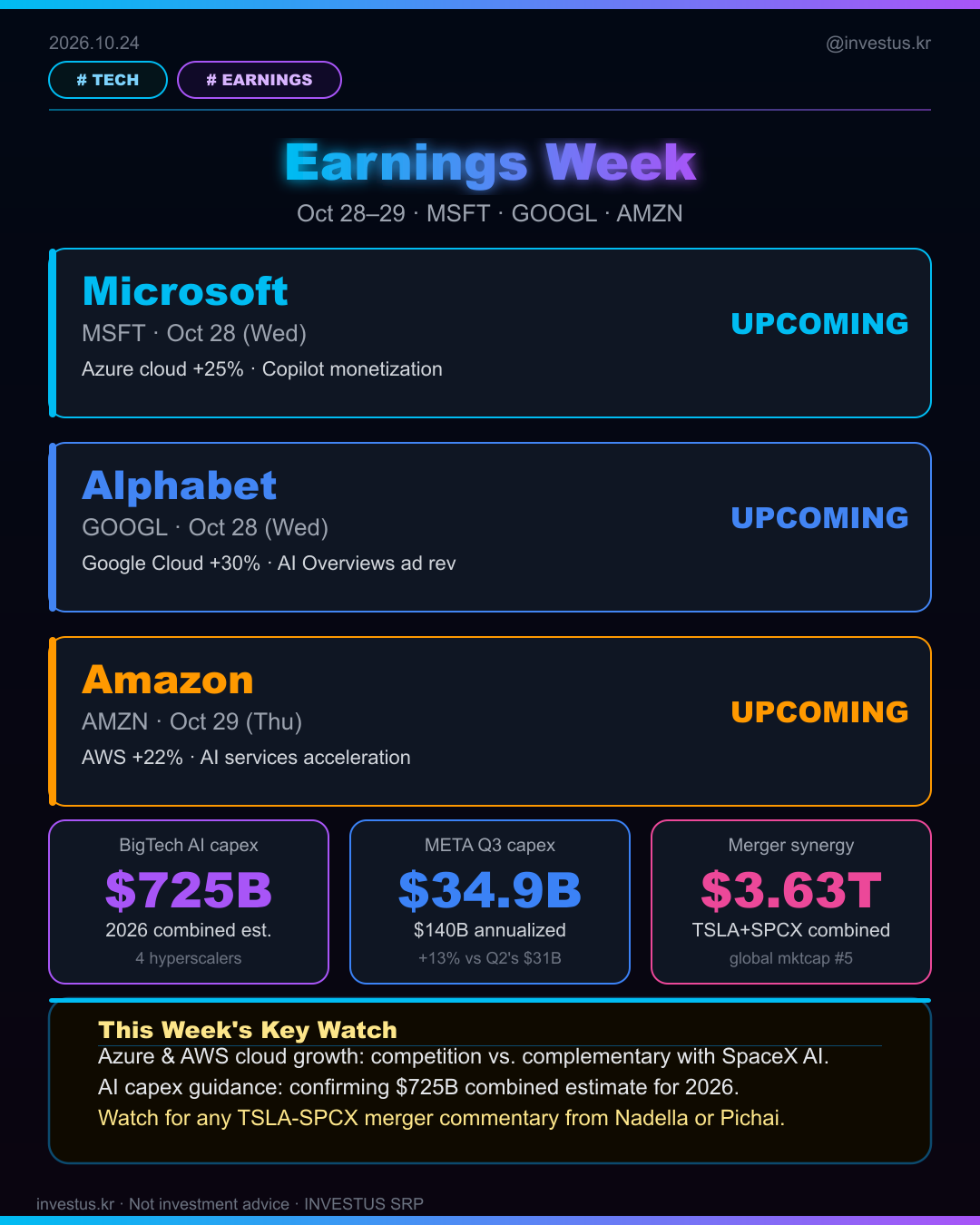
This week's big tech earnings: Microsoft and Alphabet report Oct 28, Amazon Oct 29. Meta Q3 (already reported Oct 21) confirmed AI capex of $34.9B (+80% YoY). Big-4 hyperscaler combined 2026 AI capex is estimated at ~$725B. Key metrics: Azure cloud growth (+25% est), Google Cloud (+30% est), AWS (+22% est), and whether AI capex guidance is raised again. Any TSLA-SPCX merger commentary from Nadella or Pichai would be a notable sideshow.
What Happened
Big Tech earnings season hits full stride this week. Following Meta (Oct 21), Microsoft and Alphabet report simultaneously on Wednesday Oct 28 after market close. Amazon reports Thursday Oct 29. Apple follows on Oct 31. Meta's Q3 already confirmed: AI capex $34.9B (+80% YoY from $19.4B). Combined big-4 (Meta + MSFT + GOOGL + AMZN) AI capex for 2026 is estimated at ~$725B — the largest single-year AI infrastructure investment in history.
Three things matter most this week. First: cloud growth rates. Azure, Google Cloud, and AWS quarterly growth will validate or challenge the AI demand narrative. Consensus: Azure +25%, Google Cloud +30%, AWS +22%. Beats here confirm AI infrastructure demand continues to exceed supply. Second: AI capex guidance. Microsoft already raised from $175–185B to $180–190B in the prior update — will there be further raises? Third: AI monetization. Copilot (MSFT) and Gemini (GOOGL) actual revenue contribution is the key ROI question the market is watching.
A possible sideshow: questions about SpaceX AI compute vs. hyperscaler relationships. SpaceX building 10GW of self-owned AI compute while trying (and failing) to rent Azure/GCP/AWS capacity is structurally significant. Any commentary from Nadella or Pichai on SpaceX as customer vs. competitor would be notable.
More Context
$725B combined AI capex is approximately 1.5× the US federal government's annual discretionary spending. A significant portion flows to NVDA GPUs, data center construction, and power infrastructure. SpaceX's decision to build 10GW internally is directly because external GPU capacity was unavailable globally — Musk disclosed on the earnings call that NVDA GB300/200, H100s, Google TPUs, and Amazon Trainium were all out of stock worldwide.
The structural question: is big-tech AI capex competing with SpaceX AI compute, or are they targeting different markets? SpaceX AI is primarily internal (training/inference for its own SuperIntelligence), not a cloud service. The competition is at the GPU and power supply layer, not the service layer.
Key View
Jefferies: if cloud acceleration is confirmed this week, the AI infrastructure cycle extends through 2027. Bernstein: actual cloud growth rates are justifying capex; the ROI debate is a non-issue at current growth rates. Goldman Sachs: big-tech AI spending is a 5+ year competitive moat investment — short-term profit pressure is the cost of staying relevant. MSFT/GOOGL/AMZN results are also a read-through for NVDA supply demand and for whether SpaceX's AI compute thesis has supportive industry tailwinds.
Sources & further reading
See the body and ticker IR links for sources on this note.
Related Guides
Related articles
Anthropic's $120.5B SpaceX Compute Deal: What the 90-Day Exit Clause Means After the 'Mid-2027' Report
Anthropic's S-1/A caps SpaceX compute at $120.5B with a 90-day exit after early 2027. What the 'mid-2027' report adds and what remains unconfirmed.
35,578 Open Grok Build Apps: What Claroc Measured and What SpaceXSI Disputes
SpaceXSI's Grok Build: Claroc says 35,578 published apps opened with no sign-in. What was measured, what SpaceXSI disputes, and open questions.
Starship Flight 15 Explained: SpaceX's First Attempt to Catch Both Stages, What Is Confirmed and What Investors Should Watch
SpaceX says Starship Flight 15 is preparing to launch as soon as Friday, November 13, 2026, pending regulatory approval, on the first plan to catch both Super Heavy and the Starship upper stage. The 75-minute window opens at 4:45 p.m. CT. This note separates confirmed facts, company plans, secondary reports, and open questions. It is not a buy, a sell, or a share-price call.
Disclaimer
This article is editorial research for informational purposes only. It is not investment advice, a recommendation, or a solicitation to buy or sell any security, and does not guarantee any return. Markets carry risk of loss. Verify figures against the primary sources before making decisions.