A Tesla Semi burned on I-880 with no crash — the same week public 1.2 MW Megachargers opened at Pilot stops
Published · Updated · By Investus editorial desk (SUNRYU Partners)
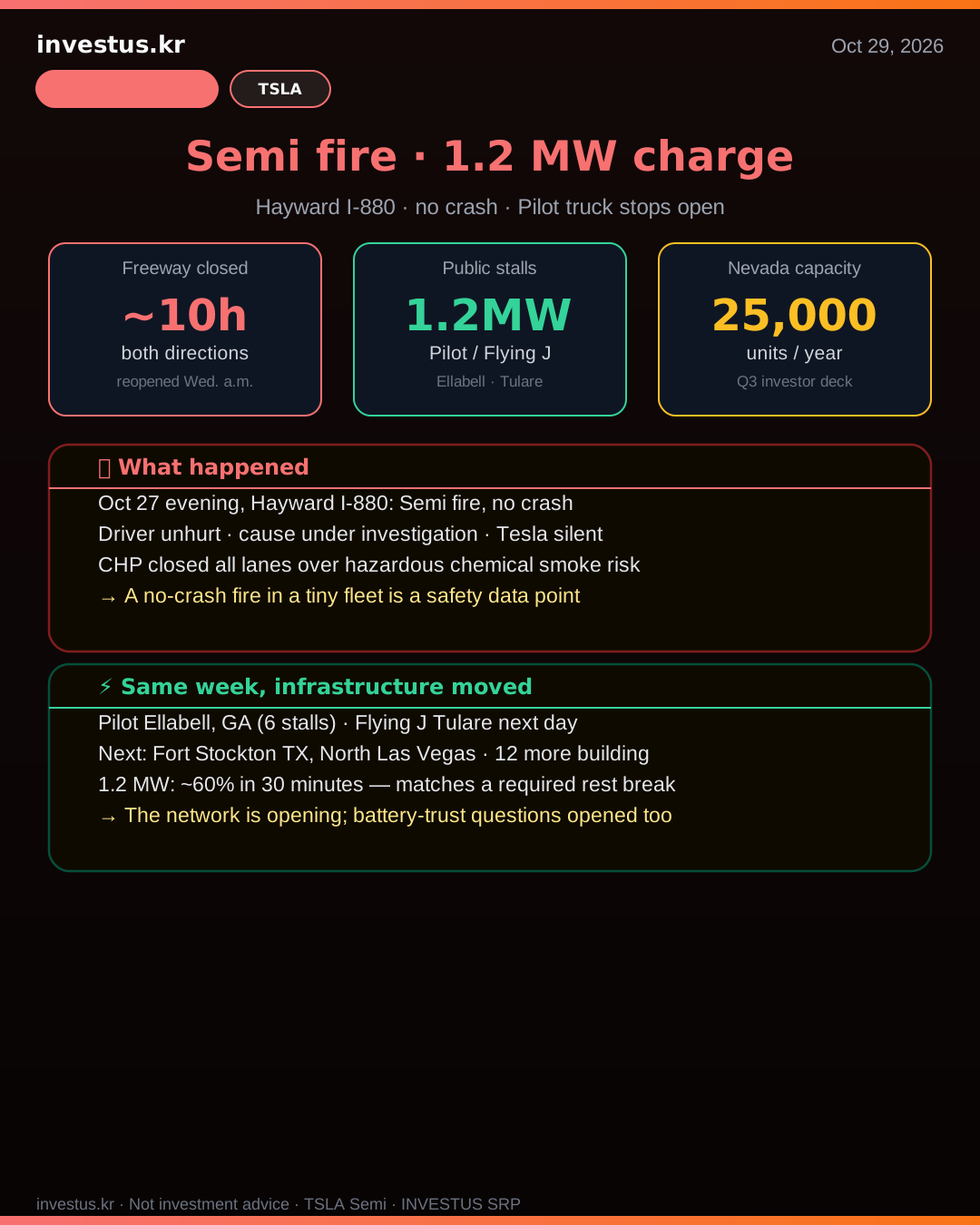
On the evening of Oct. 27, 2026 a Tesla Semi caught fire on I-880 in Hayward, California, with no crash. The driver was unhurt; the freeway stayed closed about 10 hours; the cause is under investigation. The same week, Pilot/Flying J opened its first 1.2 MW Megachargers for the Semi at Ellabell, Georgia and Tulare, California, with Fort Stockton, Texas and North Las Vegas next. Infrastructure progress and battery-safety risk arrived in the same news cycle.
What happened
California Highway Patrol's Hayward office said a Tesla Semi caught fire in the southbound lanes of Interstate 880 near Route 92 at about 5:35 p.m. Pacific Time on Tuesday, Oct. 27, 2026. Electrek (Fred Lambert, Oct. 28) reported there was no collision. The driver got out unhurt and told officers the truck caught fire for reasons they did not know. CHP closed both directions, citing the risk of hazardous chemical smoke.
Northbound reopened Tuesday night. Southbound took longer. CHP initially warned the pack could burn 15 to 18 hours; crews beat that estimate, and all lanes were posted open around 3:30 a.m. Wednesday — roughly 10 hours after the fire started. Photos from the scene show foam around a burned-out tractor and the front of a Premier Trailer Leasing trailer charred behind it. The operator has not been identified. Tesla, which does not run a conventional press office, had not commented. The cause is under investigation.
The same news week, the charging map moved. The Drive (Andrew P. Collins, Oct. 28) reported that Pilot, which also runs Flying J and is the largest U.S. truck-stop operator, opened its first Tesla Semi Megachargers: six 1.2-megawatt stalls at a Pilot in Ellabell, Georgia, and a Flying J in Tulare, California, the next day. Fort Stockton, Texas and North Las Vegas are next, with 12 more sites under construction. Until now, public Semi charging outside Tesla's own sites was essentially a Southern California story. Ellabell is the first public customer-facing Megacharger outside the state.
What it means for investors
For fleet buyers, charging — not the truck brochure — has been the bottleneck. Tesla-owned sites at Giga Nevada and a depot near the Port of Long Beach, plus a handful of customer sites in Southern California, do not look like a national diesel network. A TA stop in Ontario, California has been open since March, but at 750 kW. Electrek counted four customer-facing sites and 26 stalls once Ellabell turned on. Tesla has talked about roughly 37 Megacharger sites in 2026; Semi program lead Dan Priestley has cited 46 by early 2027. As of February the company's map showed 64 more "coming soon" pins across 15 states, led by Texas (19) and California (17). Tesla says a 1.2 MW stall can restore about 60% of a Semi's charge in 30 minutes, which is the length of the federally required break after eight hours on the wheel. That is the bull case in one sentence: the rest-break window now has a public plug, at the kind of stop diesel already uses. Pilot has more than 900 locations in the U.S. and Canada.
The catch is exclusivity and evidence. The stalls use the Megawatt Charging System connector that Daimler, Volvo and others are also building toward, and Priestley has said other trucks will eventually use them. Neither Tesla nor Pilot has said when. Tesla ran Superchargers as a walled garden for years. And there are not many Semis on the road yet. Tesla does not disclose Semi deliveries. PepsiCo, the launch customer, was around 86 trucks in 2024; volume production in Nevada only started this year. On a fleet that small, a no-crash fire is a loud data point. It is also the second Semi fire to shut a California interstate in about two years. The August 2024 I-80 fire near Emigrant Gap was first described as no-crash; the NTSB later found the truck left the road, hit a delineator and a tree, and the pack ignited after the impact. Firefighters used about 50,000 gallons of water and lanes were closed up to 15 hours. Hayward, with no crash reported, shifts attention onto the truck — pack, high-voltage system, drive units, or an ordinary tire or brake fire that spread. Electrek notes NFPA figures of 15,462 large-truck fires a year in 2018–2022, about 42 a day, in a fleet that is still overwhelmingly diesel. That is context, not a hall pass. WattEV ordered 370 Semis in May, mostly for Oakland drayage a few miles up the same I-880 corridor. In September Tesla was named lead supplier on a 2,500-truck ZET SCALE order. Safety officers at those fleets will want a cause before they treat Megachargers as the all-clear.
House views — bull and bear
Tesla's Q3 2026 investor materials already list the Nevada Semi line at 25,000 units of annual capacity in "Production." That is the installed-capacity number, not a delivery print. Goldman Sachs, among the houses that updated after the Q3 report, kept a $360 target and a Neutral rating — the low end of that day's spread (Cantor Fitzgerald $485 Overweight was the high; the average of the 10 houses that raised targets was about $436). In a Neutral frame, Semi is an execution line, not the robotaxi thesis. Public 1.2 MW stalls at Pilot support the execution line. An unexplained freeway fire leans against it. No house has published a Semi-specific target change on this fire.
The constructive view, closer to how Wedbush has talked about Tesla's energy and commercial ramp, is that chicken-and-egg charging is the thing fleet CFOs actually underwrite. A 30-minute, 60% session at a Flying J is how you argue a diesel lane can go electric without building a private depot on every corridor. The cautious view is reputational and actuarial. Class 8 buyers run safety committees. A thermal event with no crash, on a product that has barely entered volume, will show up in those rooms before it shows up in a price-target note. If the origin is a tire or a trailer, this is a trucking problem Tesla can document and move past. If the origin is the pack, the 25,000-unit capacity figure becomes a reminder of how many more packs would be on the road. This is editorial research, not investment advice, and it does not guarantee any return.
Sources & further reading
Related Guides
Related articles
Project Crystal Sun: What Musk Confirmed, What Fort Bend Agreed, and What Is Still Unverified
Musk posted the project name only. Fort Bend approved four incentive agreements. Tesla has not confirmed the site, a groundbreaking, or a production date.
Tesla Cybercab and NHTSA Special Order AQ26002: What Public Investors Can Actually Read
NHTSA’s Special Order AQ26002 asked Tesla under oath how Cybercab meets federal safety standards. What is public as of early November 2026 is a confidentiality claim over the sworn answers—especially Request 8—and a first-responder plan, not a finding of noncompliance. This guide maps the docket and Tesla’s primary filings. It is not a buy, sell, or price-target note.
Tesla confirms a Vietnam launch — into a market where VinFast already holds about 36% of new cars
A Tesla recruiter said on Oct. 28, 2026 that the company is “officially coming” to Vietnam and posted five jobs, including sales manager, service manager, and charging-project developer. Tesla Motors Vietnam LLC was registered in Ho Chi Minh City on Sept. 11. VinFast has taken about 36% of Vietnam’s new-car market in the first nine months of 2026. Southeast Asia is opening; tariffs, price, and charging will decide how large the opening is.
Disclaimer
This article is editorial research for informational purposes only. It is not investment advice, a recommendation, or a solicitation to buy or sell any security, and does not guarantee any return. Markets carry risk of loss. Verify figures against the primary sources before making decisions.