
An opinion claim says Cybercab becomes material to earnings faster than Model 3 did
Published · Updated · By Investus editorial desk (SUNRYU Partners)
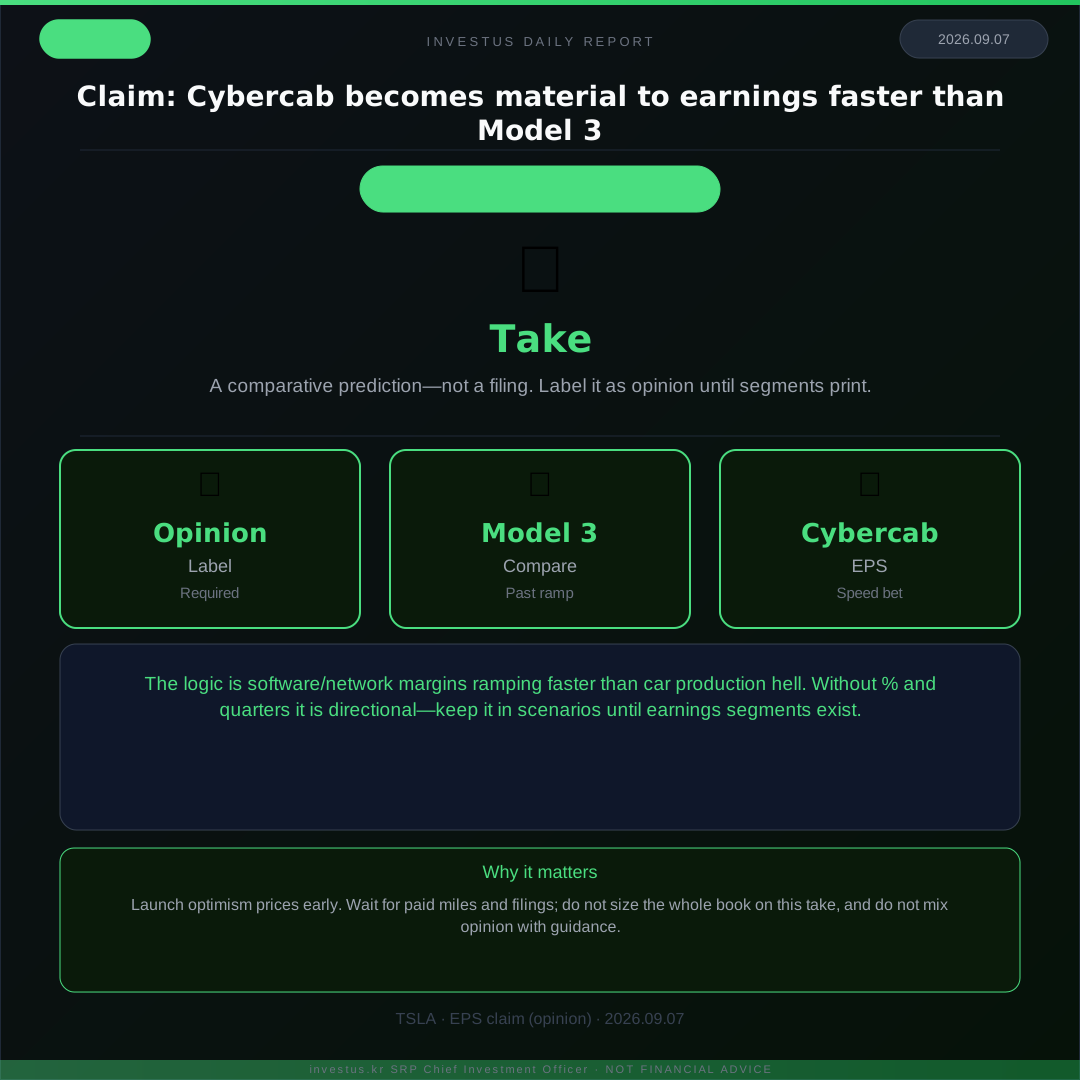
Opinion/prediction: Cybercab becomes material to earnings faster than Model 3. Structural case: software margins, near-zero marginal AI cost, 24/7 fleet utilization. Labeled as opinion — no confirmed quarterly segment data yet.
What Was Said
An opinion circulated that Cybercab will become material to Tesla's EPS faster than Model 3 did. Model 3 took about two years from mass production launch (July 2017) to its first profitable quarter (Q3 2019). The claim's core logic is that robotaxi economics are structurally faster to profitability than hardware ramp — software margins, network effects, and near-zero marginal AI cost flip the math.
"Material" in earnings context means reaching a share of revenue or profit large enough to move the needle — typically 5–10%+. Without a specific quarter or percentage attached, this is a directional opinion, not a confirmed forecast.
Why Model 3 Is the Reference Point
Model 3 is the most powerful shared memory anchor for Tesla investors. Anyone who lived through the production hell → quality hell → first profit cycle reacts immediately to "Cybercab will be faster." This is exactly why the comparison can get priced in prematurely.
Three structural reasons Cybercab could reach profitability faster: First, a single vehicle operating 24 hours generates 10× more annual revenue than a personally owned car. Second, FSD software has near-zero marginal cost per additional vehicle deployed — margin expansion accelerates as the fleet grows. Third, Tesla already has hundreds of millions of FSD miles of training data, so the model improvement cycle is vastly faster than any competitor starting from scratch.
Model 3 Timeline vs Cybercab
• Model 3 production announcement: March 2016
• First deliveries: July 2017
• Weekly 5,000-unit goal achieved: July 2018
• First profitable quarter: Q3 2019
• Tesla first full-year profit: 2020
Cybercab had 573 Texas DMV-registered units as of October 2026. For robotaxi to become "material" to EPS, the fleet needs to scale to thousands of units with per-vehicle annual revenue covering vehicle cost. At $25,000 vehicle cost and $100–$150/day average revenue, the payback period is roughly 6–9 months — far shorter than a hardware production ramp.
Counterarguments and Risks
Regulatory approvals vary city by city — Texas and California are live, but national scale requires further permitting. Any unsupervised accident creates immediate regulatory headwind. Utilization rate — how many paid hours each Cybercab runs per day — is the central unit economics variable and has not yet been publicly reported. Price competition from Waymo, Uber, and Lyft could compress per-mile rates.
Scenarios
Bull: Robotaxi segment contribution appears in a Q4 2026 or Q1 2027 earnings call, validating the faster-than-Model-3 claim and re-rating TSLA higher. Bear: Contribution is delayed to 2028+, the Model 3 comparison retreats, and valuation compresses. Risk: Unsupervised accident or regulatory freeze halts expansion — contribution turns negative before it turns positive.
Investment Takeaways
This is opinion, not confirmed guidance. The structural case for faster-than-Model-3 profitability is real, but the data to confirm or deny it does not exist yet. Watch the Q4 2026 earnings call for any robotaxi segment disclosure. Do not size a full position on this thesis before quarterly segment numbers appear.
Sources & further reading
Related Guides
Related articles
Project Crystal Sun: What Musk Confirmed, What Fort Bend Agreed, and What Is Still Unverified
Musk posted the project name only. Fort Bend approved four incentive agreements. Tesla has not confirmed the site, a groundbreaking, or a production date.
Tesla Cybercab and NHTSA Special Order AQ26002: What Public Investors Can Actually Read
NHTSA’s Special Order AQ26002 asked Tesla under oath how Cybercab meets federal safety standards. What is public as of early November 2026 is a confidentiality claim over the sworn answers—especially Request 8—and a first-responder plan, not a finding of noncompliance. This guide maps the docket and Tesla’s primary filings. It is not a buy, sell, or price-target note.
Tesla confirms a Vietnam launch — into a market where VinFast already holds about 36% of new cars
A Tesla recruiter said on Oct. 28, 2026 that the company is “officially coming” to Vietnam and posted five jobs, including sales manager, service manager, and charging-project developer. Tesla Motors Vietnam LLC was registered in Ho Chi Minh City on Sept. 11. VinFast has taken about 36% of Vietnam’s new-car market in the first nine months of 2026. Southeast Asia is opening; tariffs, price, and charging will decide how large the opening is.
Disclaimer
This article is editorial research for informational purposes only. It is not investment advice, a recommendation, or a solicitation to buy or sell any security, and does not guarantee any return. Markets carry risk of loss. Verify figures against the primary sources before making decisions.