
Starlink 2.0 — One Starship Launch Equals the Bandwidth of the Entire Atlantic Cable Network
Published · Updated · By Investus editorial desk (SUNRYU Partners)
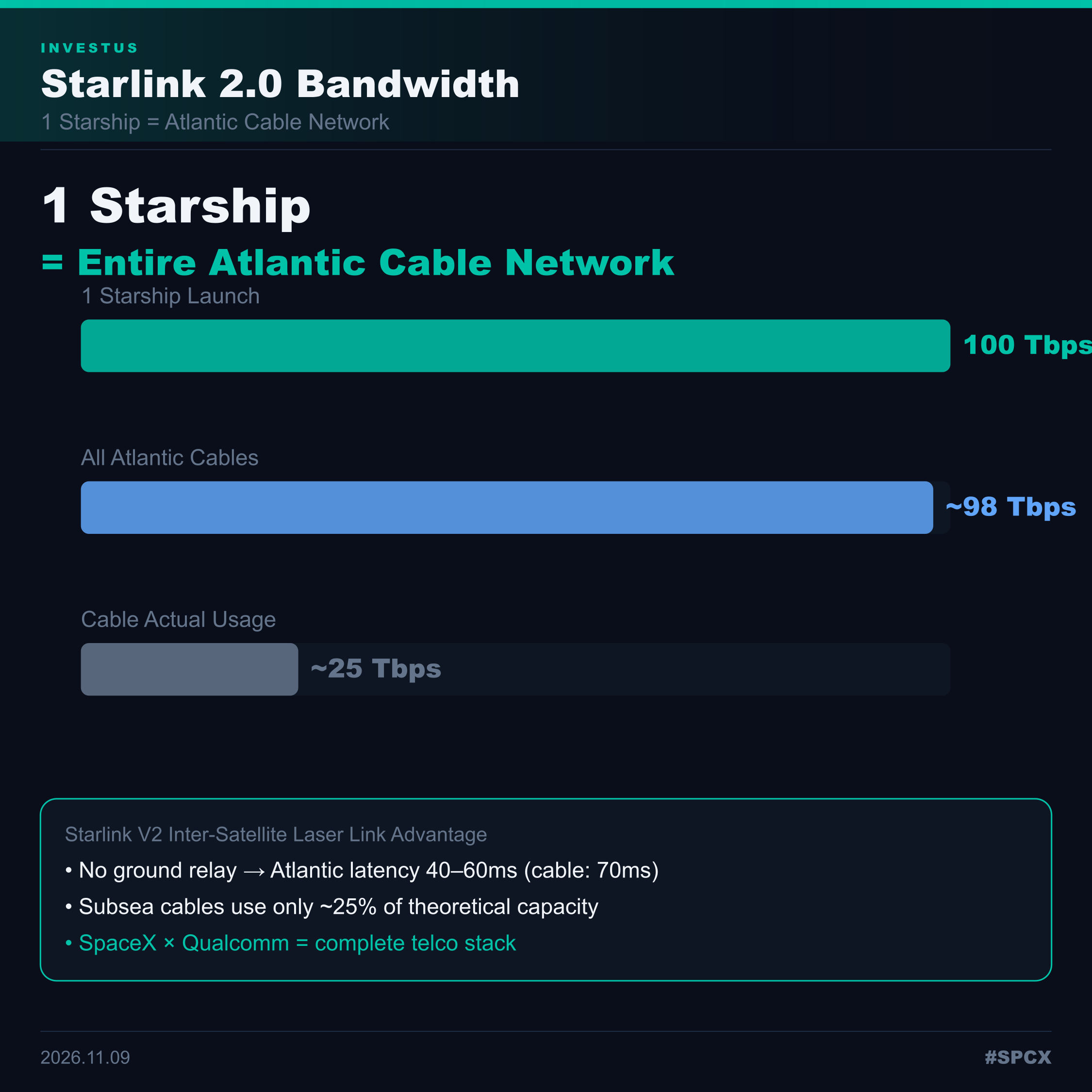
Loading 500 Starlink V2 satellites onto a single Starship is equivalent to deploying roughly 100 Tbps of fiber-optic bandwidth in one launch — matching the total usable capacity of all transatlantic subsea cables. Starlink's inter-satellite laser links bypass the terrestrial relay bottleneck entirely.
What happened
A single Starship vehicle carrying 500 Starlink V2 satellites can place approximately 100 Tbps of equivalent fiber bandwidth in orbit in a single launch. The total usable bandwidth of transatlantic subsea cables sits in a similar range, meaning one Starship mission can rival the entire Atlantic cable network's capacity — deployed from a single launch pad in Boca Chica.
Subsea cables typically operate at around 25% of theoretical capacity because fully activating their bandwidth requires amplifier stations, landing infrastructure, and content delivery networks at both ends. Starlink V2 bypasses this constraint through inter-satellite laser links, routing data at the speed of light without ground relay hops.
More detail
Starlink V2 satellites carry significantly more Ku/Ka/E-band capacity than V1, plus direct-to-cell connectivity. Inter-satellite laser links can achieve lower latency than subsea cables on long transoceanic routes — research suggests New York–London latency via laser link can reach 40–60 ms versus ~70 ms for the best subsea cable route.
Combined with Starlink's 13.6 million Q3 2026 subscriber count, the competitive picture comes into focus. Incumbent carriers have spent hundreds of billions building cable and tower networks. SpaceX is building the cost structure to put equivalent capacity in orbit per launch. The SpaceX × Qualcomm partnership announced last week would add nationwide 5G integration, completing a full telco infrastructure stack.
Analyst and house views
Morgan Stanley cites Starlink's satellite internet growth as a core pillar of SpaceX's valuation, projecting the global satellite internet market above $50 billion annually by 2030. No formal price target exists for unlisted SPCX, but subscriber growth through H2 2026 ranks Starlink among the fastest-growing consumer internet businesses globally.
investus Research
Sources & further reading
Related Guides
Related articles
Anthropic's $120.5B SpaceX Compute Deal: What the 90-Day Exit Clause Means After the 'Mid-2027' Report
Anthropic's S-1/A caps SpaceX compute at $120.5B with a 90-day exit after early 2027. What the 'mid-2027' report adds and what remains unconfirmed.
35,578 Open Grok Build Apps: What Claroc Measured and What SpaceXSI Disputes
SpaceXSI's Grok Build: Claroc says 35,578 published apps opened with no sign-in. What was measured, what SpaceXSI disputes, and open questions.
Starship Flight 15 Explained: SpaceX's First Attempt to Catch Both Stages, What Is Confirmed and What Investors Should Watch
SpaceX says Starship Flight 15 is preparing to launch as soon as Friday, November 13, 2026, pending regulatory approval, on the first plan to catch both Super Heavy and the Starship upper stage. The 75-minute window opens at 4:45 p.m. CT. This note separates confirmed facts, company plans, secondary reports, and open questions. It is not a buy, a sell, or a share-price call.
Disclaimer
This article is editorial research for informational purposes only. It is not investment advice, a recommendation, or a solicitation to buy or sell any security, and does not guarantee any return. Markets carry risk of loss. Verify figures against the primary sources before making decisions.