
Cybercab hits all-time low fare: $1.53/mile — Austin 24.3mi $37.16 night ride · 14% cheaper than UberX · 731 units daily
Published · Updated · By Investus editorial desk (SUNRYU Partners)
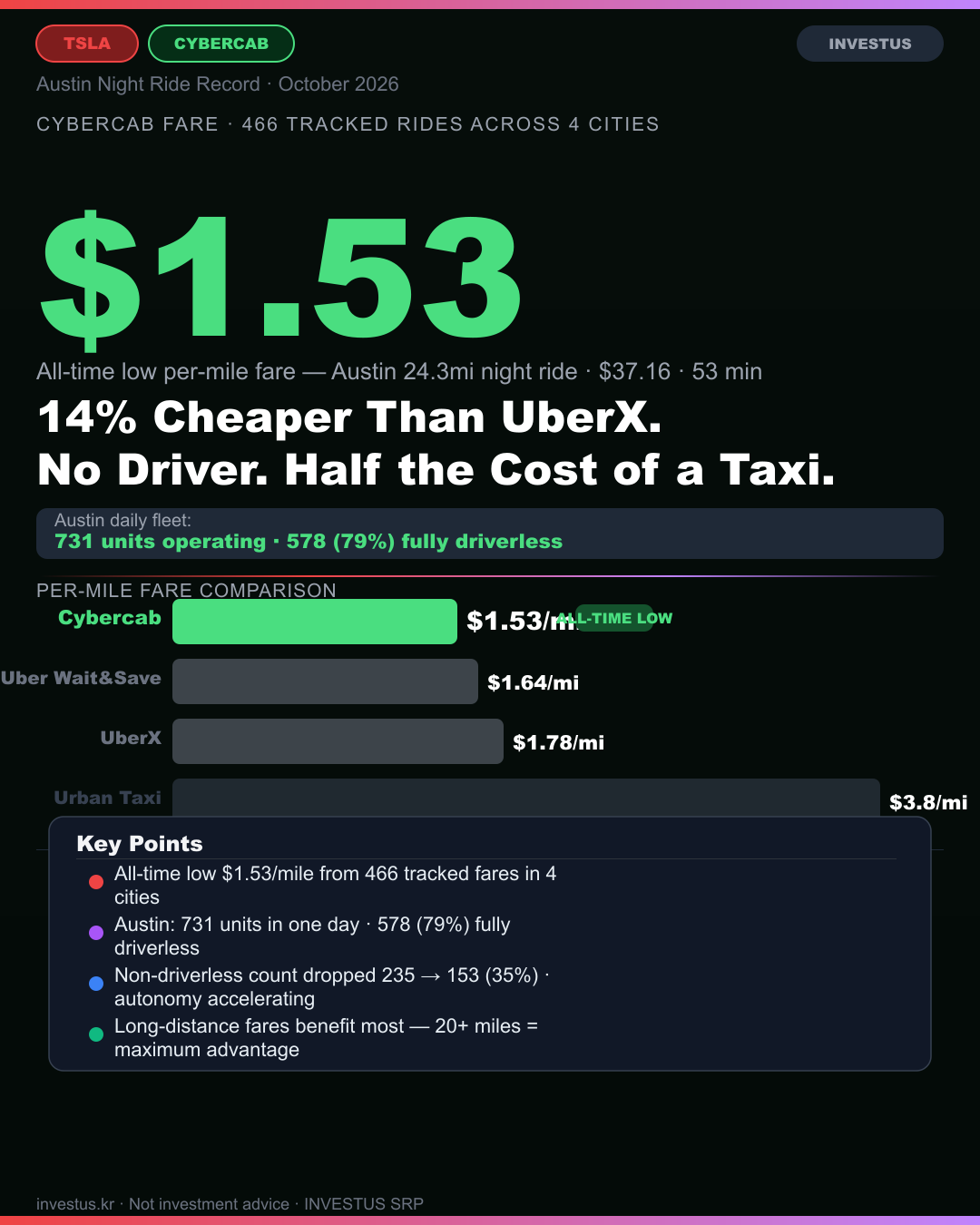
An Austin Cybercab night ride (24.3 miles, 53 min, $37.16) logged $1.53/mile — the lowest rate in 466 tracked fares across 4 cities. That's cheaper than Uber Wait & Save ($1.64/mile) and 14% below UberX ($1.78/mile). Austin logged 731 total Cybercab sightings in one day, with 578 (79%) running driverless — driverless rate up 14% week-over-week even as total count held flat.
What Happened
An Austin Cybercab night ride covered 24.3 miles in 53 minutes for $37.16 total — $1.53/mile. That's the lowest rate logged across 466 fare records in 4 cities. Benchmarks: Uber Wait & Save $1.64/mile, UberX $1.78/mile. Cybercab beat Uber's cheapest option by 7% and UberX by 14%.
Austin Cybercab: 731 total sightings in one day. 578 (79%) were driverless. Non-driverless dropped from 235 to 153 — a 35% decrease. Driverless count up 14% week-over-week. The large fleet established after Oct 3 is holding and growing.
The $1.53/mile rate is a distance-driven phenomenon: base fare spreads across more miles on long trips. Sub-5-mile rides in the city carry higher per-mile costs. The structural efficiency advantage from no driver labor + Tesla's electric drivetrain compounds on long routes.
More Context
For reference: US city taxi average is $3.5–4.5/mile, standard Uber $2.0–2.5/mile. Cybercab at $1.53/mile is 40–60% cheaper — enabled purely by removing driver cost. At 79% driverless and rising, the fleet is close to fully autonomous operation at scale in Austin.
Key View
RoboTaxi economics are determined by utilization, not per-mile fare. A 24/7 autonomous vehicle generating 20–22 hours of revenue daily has 3–4x the unit economics of a human-driven car. Even at $1.53/mile, high utilization produces superior per-vehicle profitability — which is exactly why robotaxi is ARK's primary Tesla value driver for 2031.
Sources & further reading
See the body and ticker IR links for sources on this note.
Related Guides
Related articles
Anthropic's $120.5B SpaceX Compute Deal: What the 90-Day Exit Clause Means After the 'Mid-2027' Report
Anthropic's S-1/A caps SpaceX compute at $120.5B with a 90-day exit after early 2027. What the 'mid-2027' report adds and what remains unconfirmed.
35,578 Open Grok Build Apps: What Claroc Measured and What SpaceXSI Disputes
SpaceXSI's Grok Build: Claroc says 35,578 published apps opened with no sign-in. What was measured, what SpaceXSI disputes, and open questions.
Starship Flight 15 Explained: SpaceX's First Attempt to Catch Both Stages, What Is Confirmed and What Investors Should Watch
SpaceX says Starship Flight 15 is preparing to launch as soon as Friday, November 13, 2026, pending regulatory approval, on the first plan to catch both Super Heavy and the Starship upper stage. The 75-minute window opens at 4:45 p.m. CT. This note separates confirmed facts, company plans, secondary reports, and open questions. It is not a buy, a sell, or a share-price call.
Disclaimer
This article is editorial research for informational purposes only. It is not investment advice, a recommendation, or a solicitation to buy or sell any security, and does not guarantee any return. Markets carry risk of loss. Verify figures against the primary sources before making decisions.