
SPCX — NASA Wind-Tunnel Tests Super Heavy V3 Booster · Starship HLS Artemis Missions
Published · Updated · By Investus editorial desk (SUNRYU Partners)
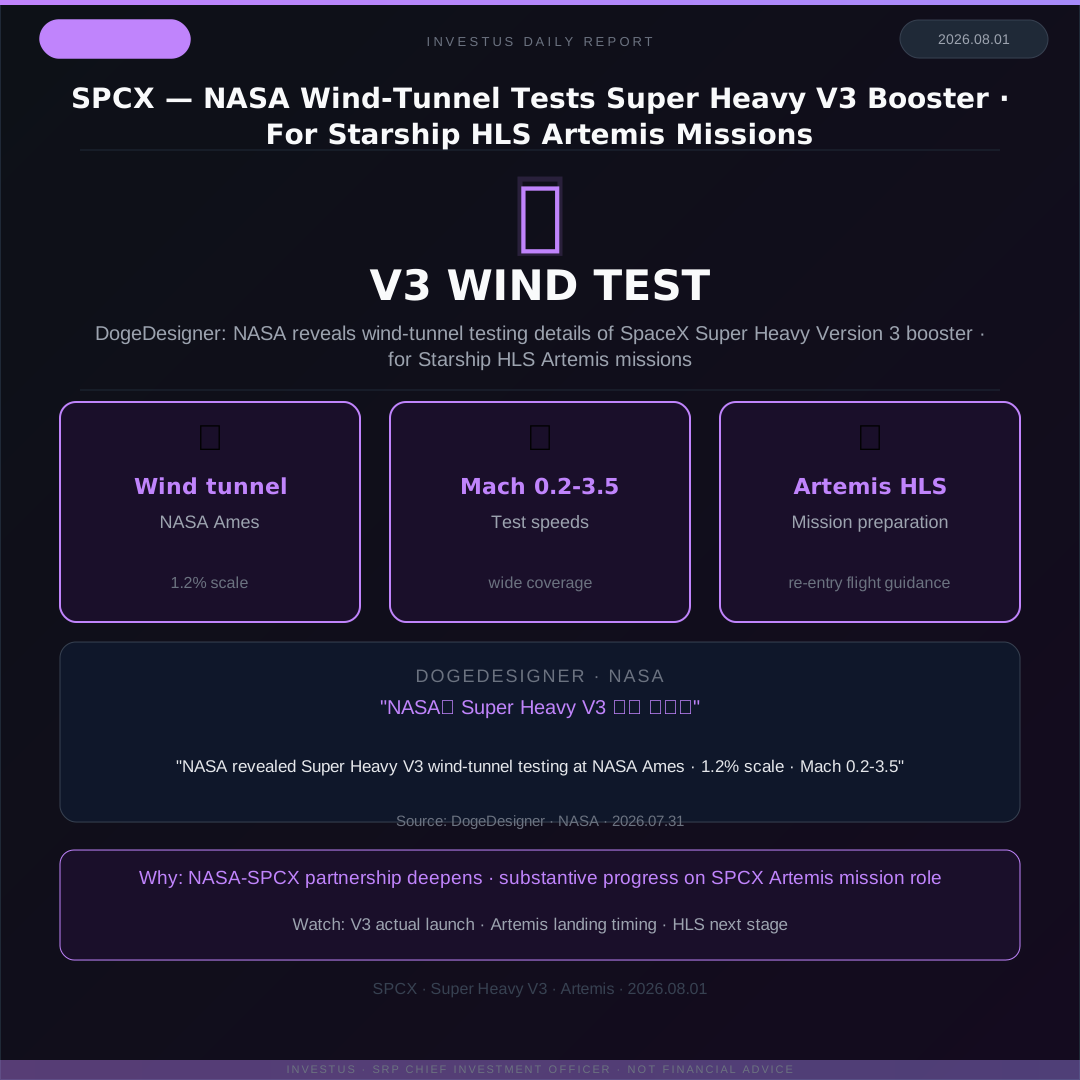
DogeDesigner: NASA reveals wind-tunnel testing details of SpaceX Super Heavy Version 3 booster · for Starship HLS Artemis missions · NASA Ames · 1.2% scale model · Mach 0.2-3.5 speeds. NASA-SPCX partnership deepens.
Test Details
Today from DogeDesigner on NASA observation:
- **Subject**: NASA (National Aeronautics and Space Administration)
- **Target**: SpaceX Super Heavy Version 3 booster
- **Test location**: NASA Ames Research Center
- **Model scale**: 1.2% (scale-down model of real vehicle)
- **Test speeds**: Mach 0.2 - Mach 3.5 (subsonic ~ supersonic)
- **Measured**: Aerodynamic forces · buffeting · vibrations
- **Purpose**: Improve re-entry flight guidance / structural-load simulations
- **Final application**: Starship HLS Artemis missions
Why This Test Matters
1. **Super Heavy V3 validation**: V3 is latest iteration · booster of large rocket to replace Falcon 9 · safety/performance validation is precondition for commercialization
2. **Artemis HLS mission prep**: Starship HLS (Human Landing System) is NASA's crewed Moon-landing program. Super Heavy V3 is launch booster for this mission
3. **NASA-SPCX partnership deepens**: NASA resources (Ames wind tunnel) used by SPCX · substance of government-private partnership
4. **Mach 0.2-3.5 wide coverage**: Wide range from subsonic to supersonic = full flight profile validation
SPCX Role in Artemis Program
Artemis (NASA crewed Moon return/settlement program):
- Starship HLS: Lunar lander (SPCX responsible)
- Super Heavy: Launch booster (SPCX responsible)
- Falcon Heavy / Falcon 9: Other payload launches (SPCX responsible)
- Dragon: Crew/cargo transport (SPCX responsible)
- Orion: Crew capsule (Lockheed Martin responsible)
- SLS: Launch rocket (Boeing responsible, delay/cost issues)
SPCX responsible for Artemis multi-axis. Today's Super Heavy V3 test is progress on this axis.
Combined With Recent SPCX·NASA Flow
- **7/27**: NASA Admin Sean Duffy bull statement
- **7/28**: Starship Flight 13 heat-shield stress test success
- **7/29**: Starship Flight 13 landing success (soft splash)
- **7/31**: US Space Force $1.8B contract
- **Today**: NASA Super Heavy V3 wind-tunnel test · Colossus BlackRock 1.2 GW · Musk 99.99% compute to space
SPCX (a) government contract expansion, (b) technical validation progress, (c) orbital DC frame strengthening on 3-fold axis expansion.
Meaning of Mach 0.2-3.5
- **Mach 0.2**: Early launch (subsonic)
- **Near Mach 1**: Sound-speed breakthrough (transonic · hardest zone)
- **Mach 3.5**: Post-atmosphere ascent (supersonic)
Wide-range speed testing = full flight profile safety/performance confirmation.
Counter-view
(1) Wind-tunnel test is one of many validation stages · actual launch validation separate, (2) 1.2% scale model can't perfectly match real vehicle, (3) Artemis HLS mission real Moon landing timing still uncertain.
Implications
1. **NASA-SPCX partnership substance**: Uses government resources · softens political/regulatory risk
2. **Super Heavy V3 real prep**: Physical basis for all-in Starship decision expanded
3. **Artemis follow-on mission support**: Real progress on crewed Moon landing
4. **SPCX price reversal material**: Substantive progress continues despite today's record-low close
Watch Next
(1) Super Heavy V3 actual launch timing, (2) Next flight test result, (3) Artemis crewed Moon landing schedule, (4) NASA-SPCX additional partnership announcements.
Sources & further reading
See the body and ticker IR links for sources on this note.
Related Guides
Related articles
Anthropic's $120.5B SpaceX Compute Deal: What the 90-Day Exit Clause Means After the 'Mid-2027' Report
Anthropic's S-1/A caps SpaceX compute at $120.5B with a 90-day exit after early 2027. What the 'mid-2027' report adds and what remains unconfirmed.
35,578 Open Grok Build Apps: What Claroc Measured and What SpaceXSI Disputes
SpaceXSI's Grok Build: Claroc says 35,578 published apps opened with no sign-in. What was measured, what SpaceXSI disputes, and open questions.
Starship Flight 15 Explained: SpaceX's First Attempt to Catch Both Stages, What Is Confirmed and What Investors Should Watch
SpaceX says Starship Flight 15 is preparing to launch as soon as Friday, November 13, 2026, pending regulatory approval, on the first plan to catch both Super Heavy and the Starship upper stage. The 75-minute window opens at 4:45 p.m. CT. This note separates confirmed facts, company plans, secondary reports, and open questions. It is not a buy, a sell, or a share-price call.
Disclaimer
This article is editorial research for informational purposes only. It is not investment advice, a recommendation, or a solicitation to buy or sell any security, and does not guarantee any return. Markets carry risk of loss. Verify figures against the primary sources before making decisions.