
SPCX vs AMZN Leo — 10,700 vs 398 Satellites · Herald CEO Race Frame
Published · Updated · By Investus editorial desk (SUNRYU Partners)
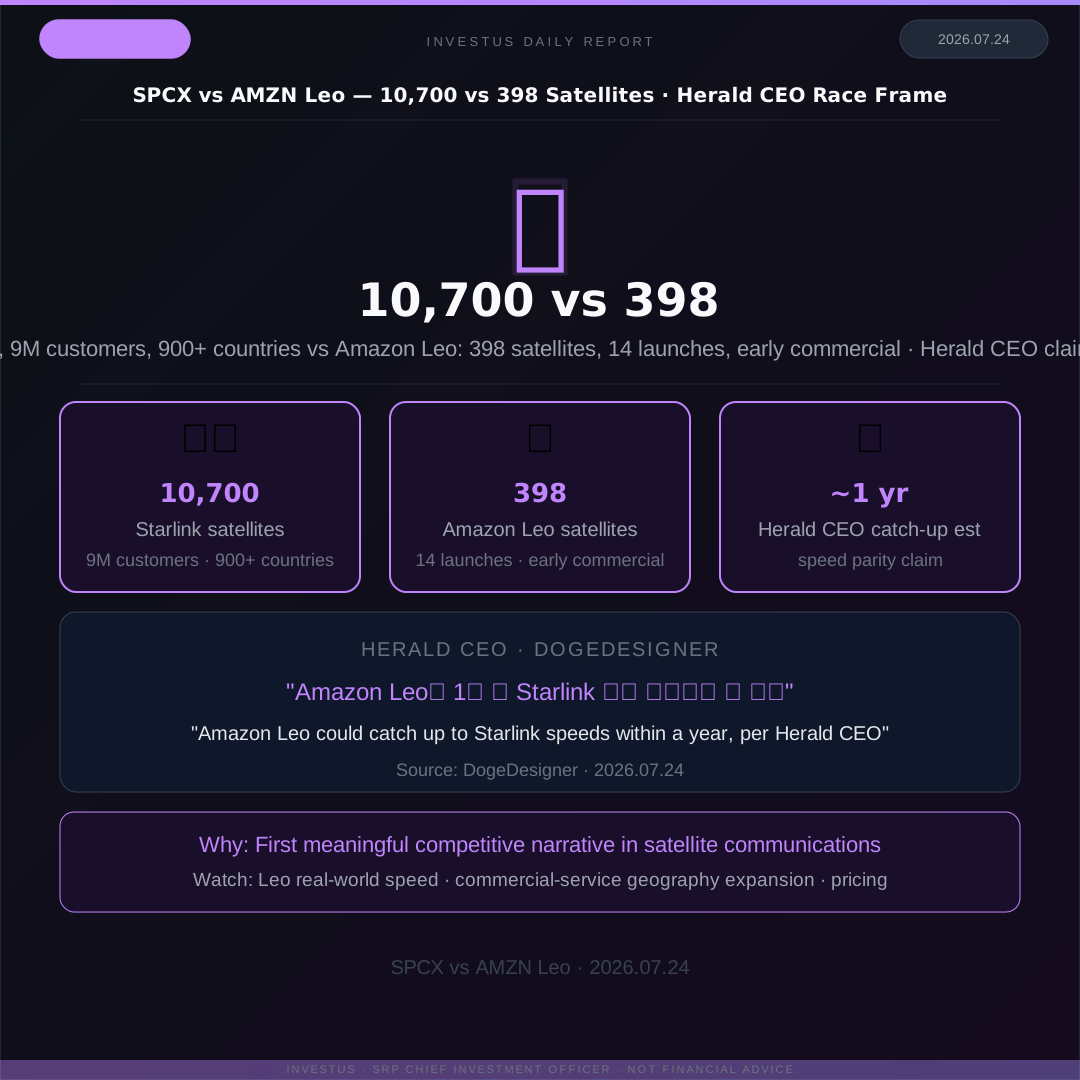
Per DogeDesigner via Herald CEO Van Zyl Botha, Amazon Leo could catch Starlink speeds within a year. Snapshot: Starlink 10,700 satellites, 9M customers, 900+ countries, 250+ launches vs Amazon Leo 398 satellites, 14 launches, early commercial, no global service. First meaningful satellite-comms competition narrative.
Snapshot
DogeDesigner's compilation of Herald CEO Van Zyl Botha's remarks with market comparison:
**Starlink (SpaceX)**
- Satellites: 10,700 (LEO)
- Customers: 9M+
- Service countries: 900+
- Launch missions: 250+
**Amazon Leo (Project Kuiper)**
- Satellites: 398
- Launch missions: 14
- Commercial state: early
- Global service: none yet
Herald CEO's Claim
Amazon Leo could catch Starlink speeds within about a year. Rationale: (1) Amazon can bundle with AWS for integrated service, (2) capacity expansion via Blue Origin launch vehicles, (3) late-entrant benefits in satellite/hardware design.
Counterpoint
Starlink already has 10,700 satellites providing wide coverage, low latency, and stable bandwidth. Scaling 398 → 10,700 requires thousands of satellite launches per year — where SpaceX (Falcon 9 reusable leadership) has an overwhelming lead. Amazon Leo relying on other launch providers is itself a structural expansion-speed constraint.
Implication
First meaningful competitive narrative in satellite comms. But how quickly the service gap actually narrows needs quantitative validation on (1) Leo launch pace, (2) commercial-service geography expansion, (3) price/speed metrics.
Sources & further reading
See the body and ticker IR links for sources on this note.
Related Guides
Related articles
Anthropic's $120.5B SpaceX Compute Deal: What the 90-Day Exit Clause Means After the 'Mid-2027' Report
Anthropic's S-1/A caps SpaceX compute at $120.5B with a 90-day exit after early 2027. What the 'mid-2027' report adds and what remains unconfirmed.
35,578 Open Grok Build Apps: What Claroc Measured and What SpaceXSI Disputes
SpaceXSI's Grok Build: Claroc says 35,578 published apps opened with no sign-in. What was measured, what SpaceXSI disputes, and open questions.
Starship Flight 15 Explained: SpaceX's First Attempt to Catch Both Stages, What Is Confirmed and What Investors Should Watch
SpaceX says Starship Flight 15 is preparing to launch as soon as Friday, November 13, 2026, pending regulatory approval, on the first plan to catch both Super Heavy and the Starship upper stage. The 75-minute window opens at 4:45 p.m. CT. This note separates confirmed facts, company plans, secondary reports, and open questions. It is not a buy, a sell, or a share-price call.
Disclaimer
This article is editorial research for informational purposes only. It is not investment advice, a recommendation, or a solicitation to buy or sell any security, and does not guarantee any return. Markets carry risk of loss. Verify figures against the primary sources before making decisions.