
Musk — Why Cybercab Scale-Up Is Slow · New Platform Needs Own Data
Published · Updated · By Investus editorial desk (SUNRYU Partners)
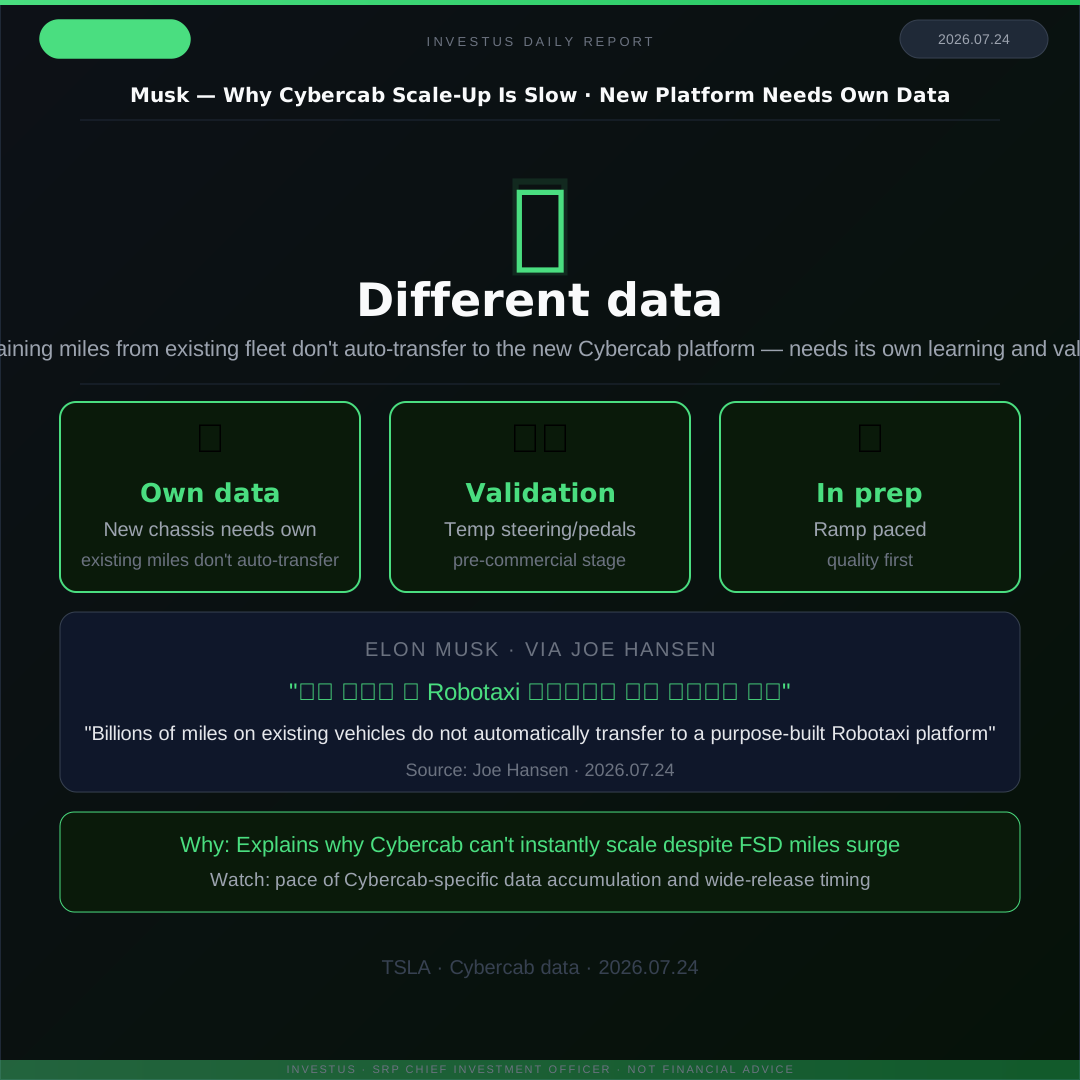
Per Joe Hansen, Musk explains: 8B+ FSD training miles from the existing fleet don't automatically transfer to the new Cybercab platform. New chassis needs its own training data · temp steering/pedals for validation · dynamics calibration · wide release after validation. Explains why Cybercab can't instantly scale despite FSD 315M miles/day surge.
Musk's Point
Per Joe Hansen's compilation of Musk's remarks, the 8B+ FSD training miles from the existing Model S/3/X/Y fleet don't auto-transfer to the new Cybercab platform, because:
1. A new chassis has different dynamics, sensor placement, and motor response — needs its own learning data
2. Must go through validation with temporary steering wheels and pedals
3. Generalized entities (car, dog, tree) processing must be re-calibrated for the new platform
4. Wide release becomes possible only after validation completes
Why This Matters Today
The same day, FSD miles/day of 315M shows exponential training-data pipeline expansion. Market/investors could easily assume that this directly translates to Cybercab commercialization speed. Musk's explanation is the CEO caveat to that expectation: data is exponential, but new-platform commercialization is tied to sequential validation.
Combining With Other Data Points Today
(1) Cybercab support code found in Robotaxi 26.6.0 app (separate report), (2) First Responder Plan v1.4 expanded to 9 Arizona areas, (3) SpaceX all-in Starship decision. Multiple axis decisions land the same day, and this Musk remark also reads as a pace-management statement.
Implication
Cybercab commercialization comes after multi-stage validation, not instantly, while FSD miles keep expanding exponentially in the meantime. The market waits for the official wide-release announcement.
Sources & further reading
See the body and ticker IR links for sources on this note.
Related Guides
Related articles
Anthropic's $120.5B SpaceX Compute Deal: What the 90-Day Exit Clause Means After the 'Mid-2027' Report
Anthropic's S-1/A caps SpaceX compute at $120.5B with a 90-day exit after early 2027. What the 'mid-2027' report adds and what remains unconfirmed.
35,578 Open Grok Build Apps: What Claroc Measured and What SpaceXSI Disputes
SpaceXSI's Grok Build: Claroc says 35,578 published apps opened with no sign-in. What was measured, what SpaceXSI disputes, and open questions.
Starship Flight 15 Explained: SpaceX's First Attempt to Catch Both Stages, What Is Confirmed and What Investors Should Watch
SpaceX says Starship Flight 15 is preparing to launch as soon as Friday, November 13, 2026, pending regulatory approval, on the first plan to catch both Super Heavy and the Starship upper stage. The 75-minute window opens at 4:45 p.m. CT. This note separates confirmed facts, company plans, secondary reports, and open questions. It is not a buy, a sell, or a share-price call.
Disclaimer
This article is editorial research for informational purposes only. It is not investment advice, a recommendation, or a solicitation to buy or sell any security, and does not guarantee any return. Markets carry risk of loss. Verify figures against the primary sources before making decisions.