
TSLA FSD — 315M Miles/Day · Up From 28.8M Just Months Ago
Published · Updated · By Investus editorial desk (SUNRYU Partners)
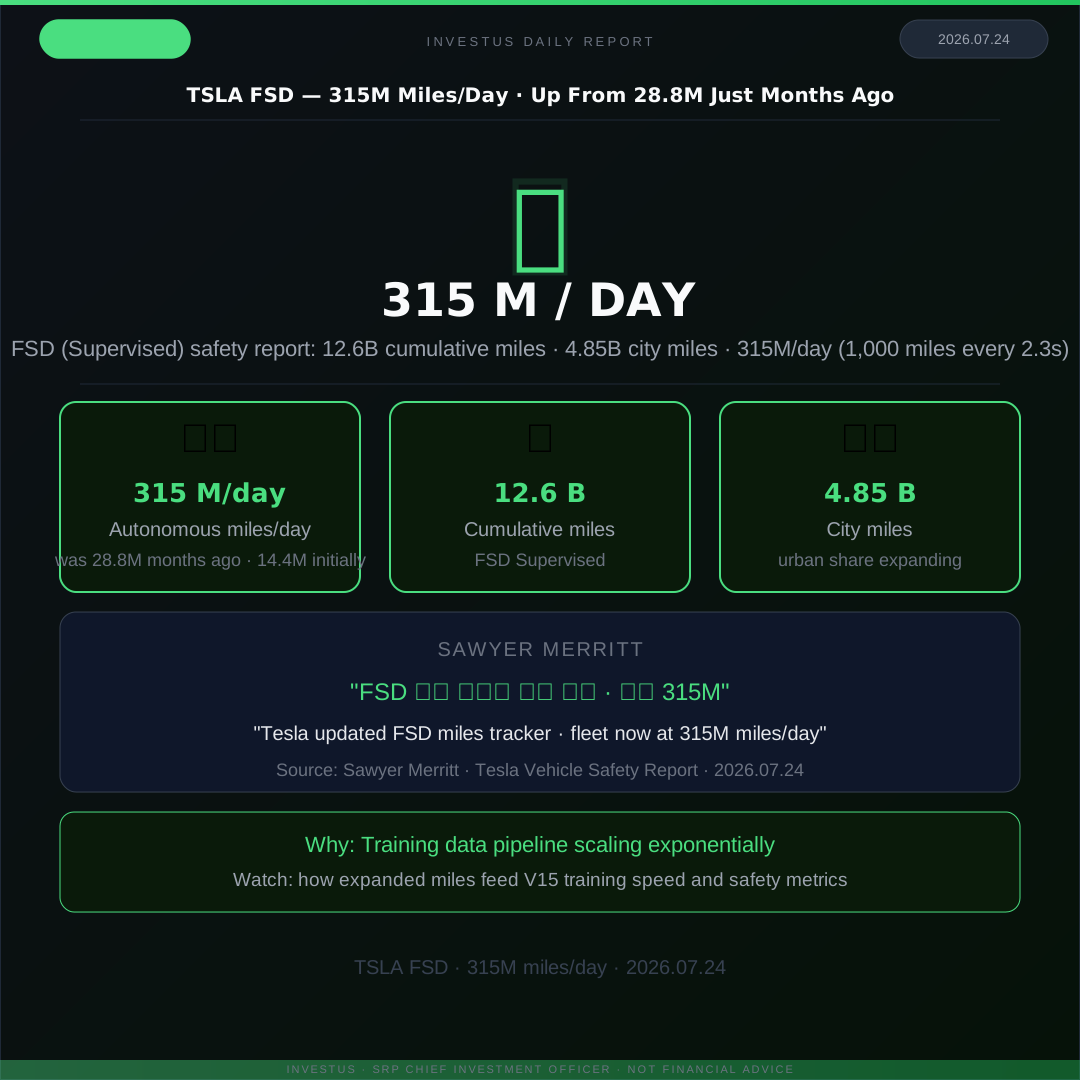
Per Sawyer Merritt citing Tesla's Vehicle Safety Report, FSD (Supervised) fleet now drives 315M miles/day — up from 28.8M months ago and 14.4M earlier this year (1,000 miles every 2.3s). Cumulative 12.6B miles total, 4.85B city miles. Training-data pipeline scaling exponentially.
Key Numbers
Big update to Tesla's Vehicle Safety Report (via Sawyer Merritt): FSD (Supervised) fleet averages 315M miles/day. Months ago it was 28.8M/day; earlier this year 14.4M/day. That's roughly 1,000 miles accumulated every 2.3 seconds.
- Cumulative total: 12,609,051,466 miles (12.6B+)
- City miles: 4,855,171,132 (4.85B+)
Why It Matters
Autonomy performance depends strongly on training-data volume and quality. 315M miles/day reflects (1) 1.48M+ active paid FSD subscribers being actually used, (2) exponential expansion in the training pipeline feeding V15, and (3) real robotaxi operations in specific cities pushing up the city-mile share.
Tie-in With Musk's Cybercab Explanation
Joe Hansen's compilation of Musk's remarks today explains why Cybercab can't instantly scale despite this massive miles surge — a new chassis needs its own data, and existing-fleet miles don't auto-transfer. Data acquisition is exponential; new-platform commercialization is throttled by validation.
Watch Next
(1) When this miles surge reflects into V15 training speed, (2) quantitative improvements in the safety report (accidents, disengagements), (3) when city-mile share expands past 40% of total.
Sources & further reading
See the body and ticker IR links for sources on this note.
Related Guides
Related articles
Anthropic's $120.5B SpaceX Compute Deal: What the 90-Day Exit Clause Means After the 'Mid-2027' Report
Anthropic's S-1/A caps SpaceX compute at $120.5B with a 90-day exit after early 2027. What the 'mid-2027' report adds and what remains unconfirmed.
35,578 Open Grok Build Apps: What Claroc Measured and What SpaceXSI Disputes
SpaceXSI's Grok Build: Claroc says 35,578 published apps opened with no sign-in. What was measured, what SpaceXSI disputes, and open questions.
Starship Flight 15 Explained: SpaceX's First Attempt to Catch Both Stages, What Is Confirmed and What Investors Should Watch
SpaceX says Starship Flight 15 is preparing to launch as soon as Friday, November 13, 2026, pending regulatory approval, on the first plan to catch both Super Heavy and the Starship upper stage. The 75-minute window opens at 4:45 p.m. CT. This note separates confirmed facts, company plans, secondary reports, and open questions. It is not a buy, a sell, or a share-price call.
Disclaimer
This article is editorial research for informational purposes only. It is not investment advice, a recommendation, or a solicitation to buy or sell any security, and does not guarantee any return. Markets carry risk of loss. Verify figures against the primary sources before making decisions.