
NVDA — Jensen Argues US Firms Should Access China's Open-Source AI
Published · Updated · By Investus editorial desk (SUNRYU Partners)
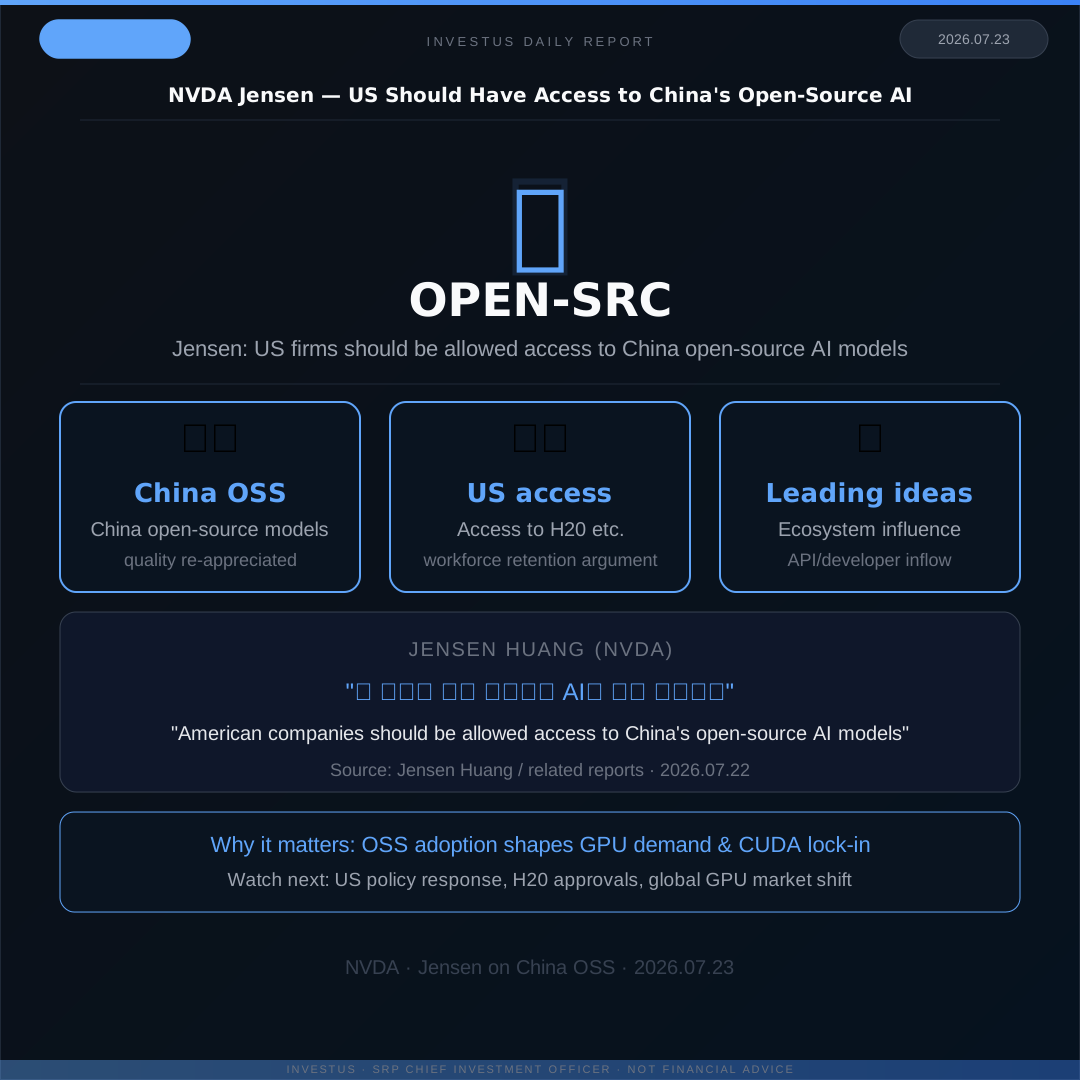
NVIDIA CEO Jensen Huang argues China's open-source AI models are excellent and US firms should have access to them. His case: restricting access risks workforce drain and losing ground in leading ideas. Combined with yesterday's MSFT × Kimi K2 Copilot story, this could escalate into a policy debate.
Jensen's Main Points
Across recent interviews and conferences, Jensen has been consistent on this thread:
- Chinese open-source AI models are excellent
- US firms should be allowed access to these models
- Restricting access risks workforce drain and losing leading-ideas ground
- Wider distribution of large models itself sustains and expands GPU demand
- Even open-source models depend on controlling data and compute access
Why It Matters for NVDA
Jensen's argument is on its face policy talk, but it ties directly to NVDA's business interests. Adoption of Chinese open models in the West (1) creates fresh demand for NVDA GPUs, (2) extends CUDA lock-in, and (3) strengthens the case to ease US restrictions on NVDA's China-facing products like H20.
Connection to Prior Reports
Read alongside yesterday's MSFT × Kimi K2 (Moonshot AI open-weight) Copilot evaluation story, today's Jensen comments make Western Big Tech adoption of Chinese open models look like a settling trend. MSFT actually loads K2 into Copilot, and Jensen publicly defends US-firm access to Chinese models. Two events inside 24 hours suggests the market is preparing for this trend.
Escalation into Policy Debate
US access to and export controls on Chinese open-source AI are geopolitically sensitive. Trump administration China policy, NVDA H20 approval outcomes, and semi export-control loosening are the debate axes. Jensen's remarks position NVDA clearly within this policy discussion.
Risk Considerations
There are counter-arguments: (1) Chinese open-model adoption may create data-leak/backdoor risks, (2) even open-source, control over training data and biases can remain in China, (3) US domestic AI competitiveness could weaken. How much these arguments influence policy decisions matters.
Watch Next
(1) US policy response (White House, Congress, Commerce Dept), (2) NVDA H20 and other China-product approvals, (3) MSFT's actual Kimi K2 adoption decision, (4) whether other Big Tech (GOOGL/META/AMZN) expands Chinese open-model adoption.
Sources & further reading
See the body and ticker IR links for sources on this note.
Related Guides
Related articles
Anthropic's $120.5B SpaceX Compute Deal: What the 90-Day Exit Clause Means After the 'Mid-2027' Report
Anthropic's S-1/A caps SpaceX compute at $120.5B with a 90-day exit after early 2027. What the 'mid-2027' report adds and what remains unconfirmed.
35,578 Open Grok Build Apps: What Claroc Measured and What SpaceXSI Disputes
SpaceXSI's Grok Build: Claroc says 35,578 published apps opened with no sign-in. What was measured, what SpaceXSI disputes, and open questions.
Starship Flight 15 Explained: SpaceX's First Attempt to Catch Both Stages, What Is Confirmed and What Investors Should Watch
SpaceX says Starship Flight 15 is preparing to launch as soon as Friday, November 13, 2026, pending regulatory approval, on the first plan to catch both Super Heavy and the Starship upper stage. The 75-minute window opens at 4:45 p.m. CT. This note separates confirmed facts, company plans, secondary reports, and open questions. It is not a buy, a sell, or a share-price call.
Disclaimer
This article is editorial research for informational purposes only. It is not investment advice, a recommendation, or a solicitation to buy or sell any security, and does not guarantee any return. Markets carry risk of loss. Verify figures against the primary sources before making decisions.