
Starship = 10× Falcon 9 capacity (half-loaded) — Flight 14 deploys 26 V3 satellites · Starlink 13.6M subscribers · Booster & Ship both recovered
Published · Updated · By Investus editorial desk (SUNRYU Partners)
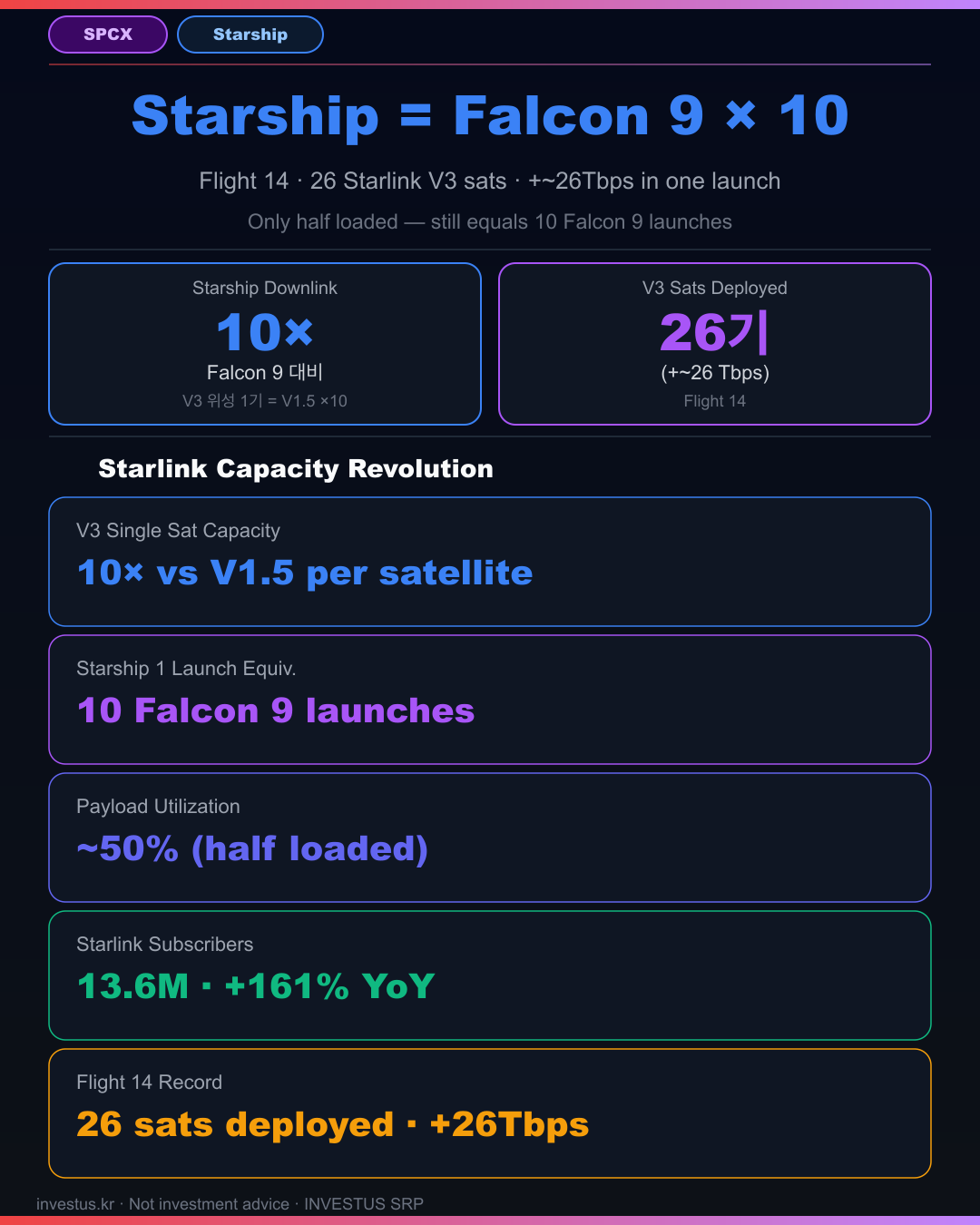
Starship Flight 14 deployed 26 Starlink V3 satellites in a single launch, adding ~26 Tbps of downlink capacity — equivalent to 10 Falcon 9 launches, and Starship was only half loaded. Each V3 satellite delivers ~10× the downlink of V1.5. Starlink subscribers: 13.6M (+161% YoY). Flight 14 recovered both Booster and Ship, confirming full reusability.
What Happened
Starship Flight 14 deployed 26 Starlink V3 satellites in a single launch — adding ~26 Tbps of downlink capacity. One Starship launch equals roughly 10 Falcon 9 launches in total downlink capacity, and Flight 14 was only about half loaded. Each V3 satellite carries ~10× the downlink capacity of V1.5. This fundamentally changes the economics of Starlink expansion.
Starlink subscribers reached 13.6M, up +161% year-over-year. The network is actively transitioning from V1.5 to V3 — once complete, the same satellite count delivers 10× the capacity. Flight 14 successfully recovered both the Booster and the Ship, confirming full reusability and the path to rapid launch cadence.
The combination of Starship launch frequency + V3 payload per launch is the core equation of Starlink's growth trajectory. Even at constant launch frequency, Starship + V3 payloads compound network capacity exponentially versus legacy Falcon 9 + V1.5.
More Context
Starship's commercial impact goes beyond cost per kg to orbit. V3 completion means dramatic improvements in Starlink bandwidth, speed, and latency — widening the lead over all LEO competitors. Flight 14's half-payload run is intentional: 26 V3 × 10× = 260 V1.5-equivalent satellites in one launch. At full load, double that. As launch cadence rises, Starlink capacity compounds.
Key View
JPMorgan: Starship-to-V3 transition dramatically lowers Starlink's cost per bit, improving connectivity segment margins structurally. Starlink's +161% subscriber growth combined with V3 rollout positions the connectivity segment alone as a standalone SPCX growth engine by 2027–2028.
Sources & further reading
See the body and ticker IR links for sources on this note.
Related Guides
Related articles
Anthropic's $120.5B SpaceX Compute Deal: What the 90-Day Exit Clause Means After the 'Mid-2027' Report
Anthropic's S-1/A caps SpaceX compute at $120.5B with a 90-day exit after early 2027. What the 'mid-2027' report adds and what remains unconfirmed.
35,578 Open Grok Build Apps: What Claroc Measured and What SpaceXSI Disputes
SpaceXSI's Grok Build: Claroc says 35,578 published apps opened with no sign-in. What was measured, what SpaceXSI disputes, and open questions.
Starship Flight 15 Explained: SpaceX's First Attempt to Catch Both Stages, What Is Confirmed and What Investors Should Watch
SpaceX says Starship Flight 15 is preparing to launch as soon as Friday, November 13, 2026, pending regulatory approval, on the first plan to catch both Super Heavy and the Starship upper stage. The 75-minute window opens at 4:45 p.m. CT. This note separates confirmed facts, company plans, secondary reports, and open questions. It is not a buy, a sell, or a share-price call.
Disclaimer
This article is editorial research for informational purposes only. It is not investment advice, a recommendation, or a solicitation to buy or sell any security, and does not guarantee any return. Markets carry risk of loss. Verify figures against the primary sources before making decisions.